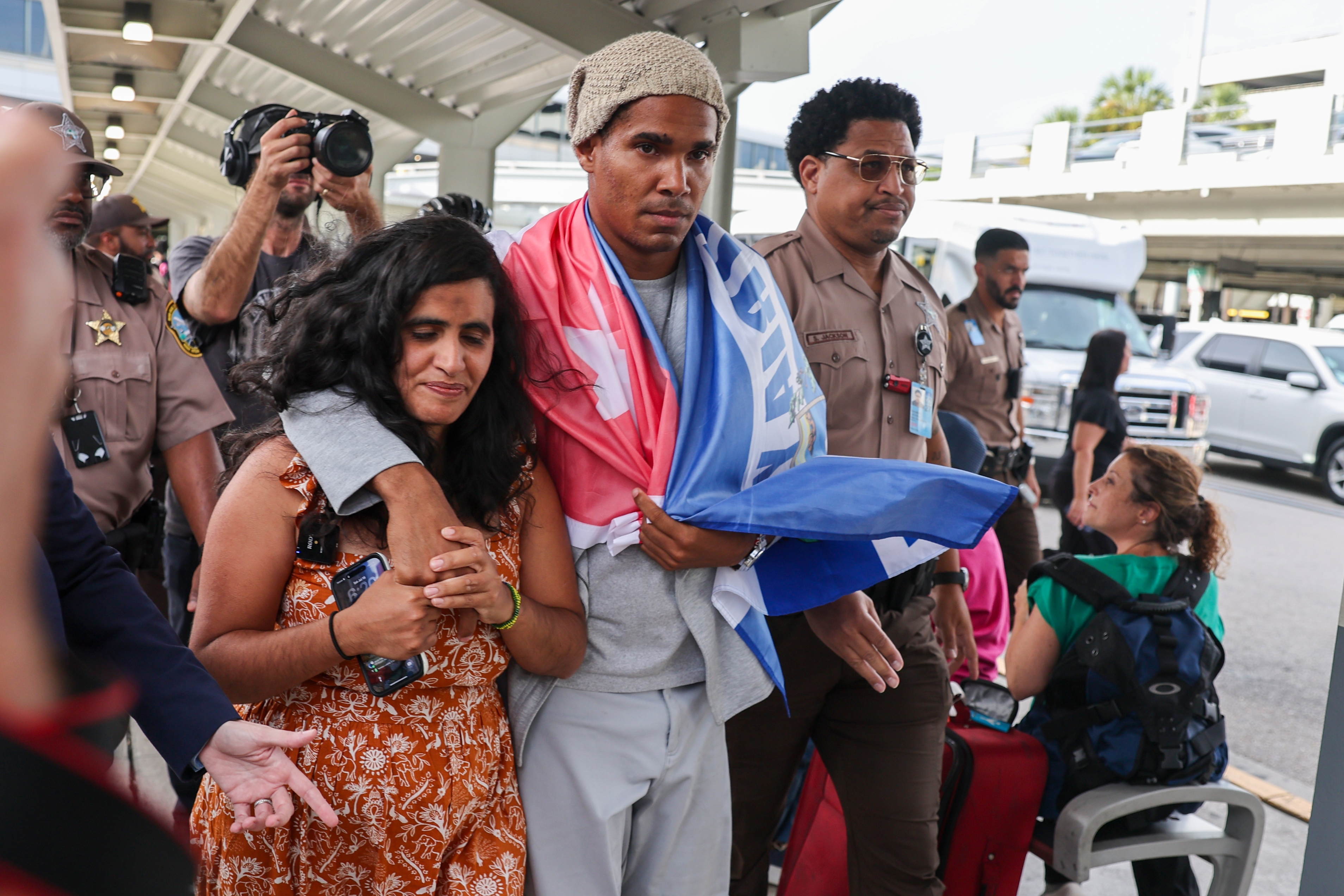
A broken statue of the Virgin Mary wrapped in a Cuban flag arrived at Miami International Airport on Saturday. The man holding it had just stepped off a plane, blinking against the flashbulbs of cell phones and the roaring cheers of hundreds of exiles. Luis Manuel Otero Alcantara, one of Cuba's most recognizable dissident artists, was finally out of a maximum-security prison. But his freedom came with a brutal condition. He had to leave his homeland forever.
For five long years, the Cuban regime tried to bury Alcantara in a concrete cell. They failed. His arrival in the United States marks the end of a terrifying saga of state-sponsored isolation, but it also highlights a grim reality. Havana still uses forced exile as its favorite weapon to neutralize anyone who dares to speak out. The message from the communist government is clear. If your art makes people question the system, you will be locked up until you agree to vanish. For a more detailed analysis into similar topics, we suggest: this related article.
This isn't just a story about a single artist getting a second chance in Miami. It's a window into a massive, ongoing crackdown that has filled Cuban prisons with more political detainees than at any point in recent history. Understanding why a painter and musician terrified a military dictatorship helps explain why the fight for Cuba's future is far from over.
The San Isidro Movement and the Threat of Free Expression
To understand why the state spent so much energy trying to crush Alcantara, you have to look at where he came from. He didn't operate out of a high-end, air-conditioned gallery. He lived and worked in San Isidro, a poor, crumbling neighborhood in Old Havana. In 2018, the Cuban government passed Decree 349, a law that legally required all artists to obtain prior approval from the Ministry of Culture before presenting their work. It was total censorship wrapped in bureaucratic language. For additional context on the matter, in-depth coverage can also be found on Al Jazeera.
Alcantara didn't comply. Instead, he co-founded the San Isidro Movement, a collective of independent artists, writers, and musicians who decided to push back. They turned their bodies, their neighborhood walls, and their music into sites of resistance.
The regime viewed this as an existential threat. Historically, the government could easily dismiss traditional political dissidents as fringe actors funded by foreign interests. But independent artists who spoke the language of the street were different. They reached the youth. They wrote songs that people danced to.
Alcantara specialized in performance art that weaponized national symbols. He walked through Havana wearing the Cuban flag as a second skin, challenging the law that restricted its use to state-sanctioned events. The government called it disrespect toward national symbols. Everyday Cubans saw it as an act of profound reclamation.
How a Song Shattered a Dictatorship Slogan
For decades, the ruling communist party forced citizens to repeat the slogan created by Fidel Castro: Patria o Muerte—Homeland or Death. It was a grim ultimatum that demanded total submission to the state.
Alcantara and a group of Afro-Cuban musicians decided to flip the script. They recorded "Patria y Vida"—Homeland and Life. The track became an overnight anthem. It explicitly rejected the regime’s death cult and demanded a future where Cubans could live, breathe, and prosper in their own country.
The song went viral online, bypassing state media filters. It eventually won a Latin Grammy, turning international eyes toward the island's growing domestic opposition. The track provided the literal soundtrack for the historic mass protests that erupted across Cuba on July 11, 2021.
Tens of thousands of Cubans took to the streets, fed up with chronic food shortages, rolling blackouts, and lack of freedom. They screamed "Patria y Vida" in the faces of riot police.
Alcantara never got to see the full scale of the protests he helped inspire. As he left his Havana home on July 11 to join the crowds, state security forces grabbed him. They threw him into a maximum-security prison, away from his community, his family, and his brushes.
A closed-door court sentenced him to five years in prison for public disorder, contempt, and his ongoing performance art. Amnesty International quickly designated him a prisoner of conscience. The government dismissed the global outrage, claiming he was simply a mercenary working to destabilize the nation.
Five Years inside the Black Hole of Maximum Security
Prison life for a high-profile political detainee in Cuba is designed to break the mind. Alcantara spent years subjected to intense psychological pressure, solitary confinement, and highly restricted communication. The state wanted him forgotten. They wanted the world to move on to the next news cycle.
The cruelty didn't stop when his five-year sentence approached its official end date. Earlier this month, guards moved Alcantara from his regular prison cell to an undisclosed state security facility. For days, his family and legal advocates had no idea where he was. The silence was terrifying.
The Miami-based legal organization Cubalex had to file an emergency habeas corpus petition just to force the government to acknowledge where they were holding him. It turned out the authorities were keeping him completely isolated until they could guarantee his immediate removal from the island.
The United States government approved a humanitarian parole application for Alcantara, offering him a way out. For the Cuban regime, this was the perfect opportunity. They offered him a stark choice: stay in a cell indefinitely or board a one-way flight to Miami.
He took the flight. His friends confirmed it was the only viable path to save his life and continue his work. But make no mistake, this wasn't a release. It was a forced expulsion.
The Grim Legacy of Forced Exile as a Weapon
Banishing dissidents is a classic strategy for the Cuban government. By shipping critics overseas, the state removes the catalysts for domestic unrest while avoiding the international bad press of keeping famous artists behind bars forever.
It creates a complex emotional vacuum for those who leave. You get your physical freedom, but you lose your canvas, your neighborhood, and the people you are fighting for. The government wins a temporary reprieve from domestic protests, and the dissident has to rebuild their life from scratch in a foreign country.
When Alcantara walked into the Miami airport, he didn't just carry a suitcase. He carried a broken statue of the Virgin Mary. He told reporters it represented the fragmented state of his country. He sees his new mission as trying to piece those fragments back together from the outside.
Yet the fight inside Cuba remains incredibly dangerous. The human rights organization Prisoners Defenders recently documented over 1,300 political prisoners currently held on the island. Shockingly, dozens of those detainees were arrested as minors, and many are still trapped in adult detention centers.
The island is trapped in a devastating economic spiral. A combination of internal government mismanagement, severe domestic fuel shortages, and strict external trade pressures has left the population desperate. Frequent power failures paralyze entire cities for days at a time. Instead of fixing the infrastructure, the government spends its energy tracking down teenagers who post criticisms on Facebook.
The Struggle for the Prisoners Left Behind
Alcantara is safe in Florida, but his first public statements focused heavily on the people he left behind in the cells of Guanajay and Combinado del Este. Specifically, he highlighted the case of Maykel "Osorbo" Castillo Perez.
Castillo Perez, a fellow Afro-Cuban musician who co-wrote "Patria y Vida," remains locked up under similar charges. He faces the same brutal conditions that Alcantara survived. The international community must realize that celebrating Alcantara’s arrival in Miami shouldn't distract from the hundreds of independent thinkers still suffering in Cuban prisons.
Human rights advocates hope that Alcantara's high-profile exile will reignite global pressure on Havana. The European Union, Washington, and Latin American democracies need to stop viewing these arrests as isolated incidents of lawbreaking. They are part of a systematic campaign to eliminate independent thought.
Concrete Steps for Global Supporters
If you want to support independent Cuban artists and political prisoners, sitting back and reading the news isn't enough. The regime thrives when the world looks away. Here is how you can actually take action.
First, support organizations on the ground that document human rights abuses. Groups like Cubalex provide vital legal assistance to families who have no voice inside the closed Cuban judicial system. Donating to these groups helps fund the legal frameworks needed to challenge arbitrary detentions.
Second, amplify independent Cuban media and art. The government spends millions keeping independent creators off the internet. By sharing their music, their digital art, and their writing, you bypass the state’s digital blockade. Listen to "Patria y Vida," understand its lyrics, and share the stories of the people who went to jail for singing it.
Third, pressure your local representatives to keep Cuba's political prisoners on the diplomatic agenda. Whether you are in the US or Europe, trade talks and diplomatic engagements should always be tied directly to the immediate release of prisoners of conscience like Maykel Osorbo.
Luis Manuel Otero Alcantara survived five years of a dictatorship's best efforts to erase him. He is out of his cell, but his exile proves that the Cuban government remains terrified of what happens when a citizen picks up a paintbrush or a microphone without permission. The cell door is open for one man, but the fight for the island's freedom continues.