The gravel crunching under my boots felt too loud for a Tuesday night. I was standing in a dark field three miles outside of town, checking my watch every two minutes, wondering why I’d traded a warm bed for a damp folding chair and a thermos of lukewarm coffee. Around me, the world was a study in silence. The crickets hadn't started their summer chorus yet, and the wind was just a cold finger tracing the back of my neck.
I was there for a ghost. Specifically, the ghost of Comet C/1861 G1 Thatcher.
Every April, our planet drifts through a cloud of debris left behind by this long-period comet. It isn't a "new" event. In fact, Chinese court astronomers recorded these same sparks in the sky back in 687 BC. That’s over 2,700 years of humans looking up, gasping, and making wishes on what is essentially cosmic trash. We call it the Lyrid meteor shower. But calling it a "shower" feels too polite, too domestic. It’s more like a celestial collision.
The Weight of a Speck of Dust
Consider a grain of sand. If you drop it on your foot, you won’t even feel it. Now, imagine that grain of sand hitting the upper atmosphere at 110,000 miles per hour.
Speed changes everything. At those velocities, the air in front of the debris can’t move out of the way fast enough. It compresses. It superheats. The grit doesn't just "burn up"; it vaporizes in a violent flash of kinetic energy, ionizing the air around it and leaving a glowing trail that can hang in the darkness for several seconds.
Physics is brutal.
When I sat there in the dark, I wasn't just thinking about the math. I was thinking about Sarah. She’s a hypothetical neighbor, the kind of person who works sixty hours a week and thinks the sky is just the thing that gets in the way of her Wi-Fi signal. If Sarah were sitting next to me, she’d ask why this matters. Why stand in the mud to watch space pebbles disintegrate?
The answer is perspective. We spend our lives staring at screens that are six inches from our faces. We worry about emails, interest rates, and whether the supermarket will have that specific brand of almond milk. Then, a streak of white light tears through the constellation Lyra, and suddenly, the "important" things feel very small. You are standing on a pressurized rock spinning through a vacuum, protected by a thin veil of gas, watching the remnants of a comet that won't return to our neighborhood until the year 2283.
The Logistics of Wonder
If you want to see this for yourself, you have to fight your own instincts. Your brain wants you to look at your phone. Don’t.
The Lyrids usually peak between April 21 and April 23. This year, the timing is a bit of a gamble. We have a moon to contend with—a bright, intrusive neighbor that acts like a streetlamp left on in a movie theater. When the moon is full or nearly so, it washes out the fainter meteors, leaving only the brightest "fireballs" visible.
But there is a trick to it.
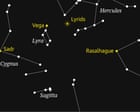
The meteors appear to radiate from a point near the star Vega, which is the brightest spark in the constellation Lyra. You don’t need a telescope. You don't need binoculars. In fact, those tools are your enemies here. They narrow your field of vision, making you miss the big picture. You need the widest possible view. You need to lie flat on your back, let your eyes adjust to the darkness for at least thirty minutes, and wait.
Patience is a dying art. We are used to "on-demand" everything. The universe, however, does not have a "play" button. You might stare at the void for twenty minutes and see nothing but the slow crawl of a satellite. Then, just as you’re about to pack up, the sky cracks open.
A Legacy Written in Oxygen and Neon
The colors aren't an accident. Sometimes a Lyrid will glow with a distinct green or blue tint. This isn't magic; it's chemistry. As the meteor burns, different elements emit different wavelengths of light. Oxygen and nitrogen in our own atmosphere glow red or green. Sodium can look orange. It’s a periodic table written in fire across the heavens.
I remember one particular streak that night. It wasn't just a flicker; it was a scar. It started high and sliced downward, lasting long enough for me to inhale sharply and point, even though there was no one there to see it. In that moment, I felt a strange connection to those Chinese astronomers from two millennia ago. They didn't know about kinetic energy or ionized gas. They probably thought the stars were falling. But the feeling—that sudden, electric jolt of awe—was exactly the same.
We live in a world that is increasingly mapped, measured, and monetized. There are very few things left that are free, unpredictable, and ancient. The Lyrids are all three. They remind us that our planet has a history that predates our cities and will outlast our empires.
The comet Thatcher is still out there, swinging through the cold outer reaches of the solar system. It is a silent, icy mountain, indifferent to our struggles. But it leaves behind these breadcrumbs, these tiny fragments of itself, just so we have a reason to look up from our mud and remember that we are part of something vast.
The Midnight Vigil
As the clock crept toward 3:00 AM, the temperature dropped another five degrees. My toes were numb. The coffee was gone. But the sky was getting busier. The Lyrids are known for "surprises." While the average rate is about 15 to 20 meteors per hour, they have been known to occasionally surge, dumping up to 100 meteors an hour on unsuspecting watchers.
It’s the gamble that keeps you in the chair.
Will you see a dud? Maybe. Will you see a fireball that lights up the ground like a lightning strike? Possibly. The uncertainty is the point. In a life of scheduled meetings and GPS-guided routes, there is something deeply healing about waiting for a light that might never come.
Eventually, the horizon began to bleed a pale, bruised purple. The stars started to retreat. I folded my chair and walked back to the car, my breath misting in the air. I didn't have any photos. I didn't have a "viral" video. I just had a memory of a streak of light that had traveled across the solar system for centuries just to end its journey in a quiet flash above a cornfield in the middle of nowhere.
The world was waking up. Somewhere, Sarah was hitting the snooze button on her alarm, unaware that the sky had been performing for her all night. I started the engine, the heater finally kicking in, and looked at the rearview mirror.
The stars were gone, but the feeling stayed. The sky isn't a ceiling. It’s an invitation. All you have to do is show up, sit in the dark, and wait for the fire to fall.