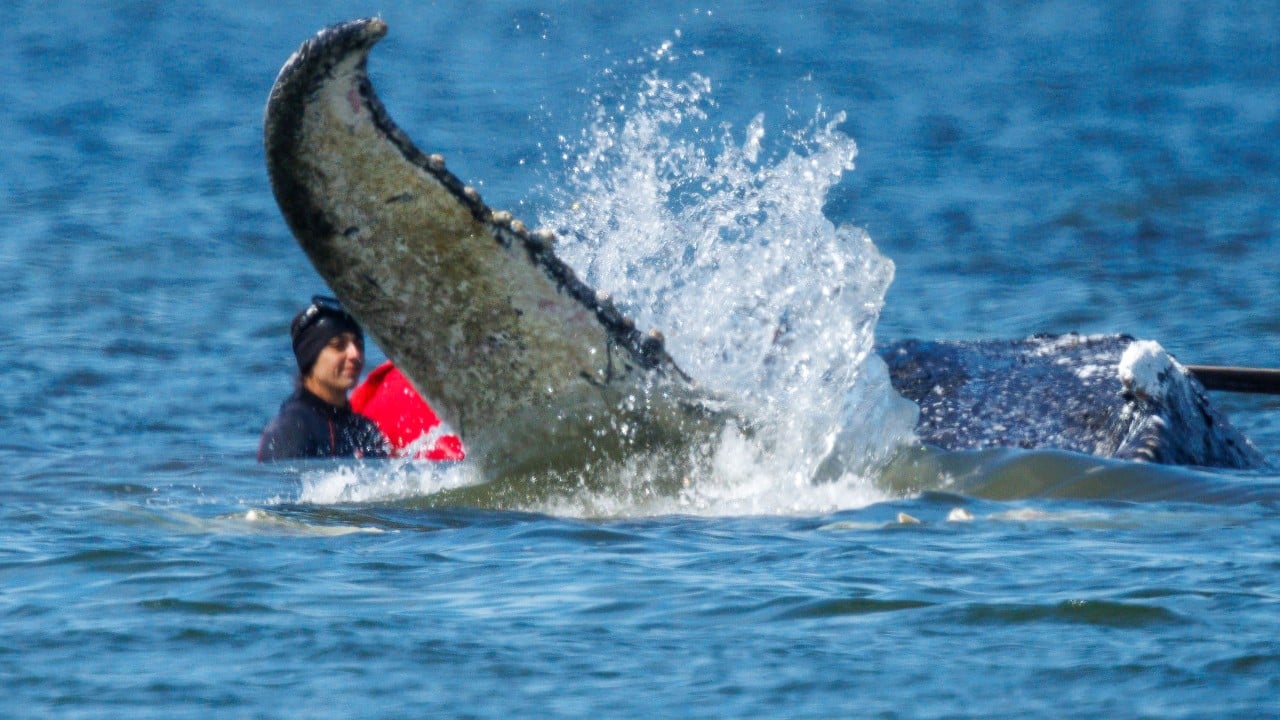
The media circus surrounding Timmy, the northern bottlenose whale that captured hearts in Germany before washing up dead in Denmark, followed a script we know all too well. First comes the frantic discovery. Then, the localized hysteria: marine biologists giving breathless updates, crowds gathered on the shore, and a collective public prayer that this magnificent creature will somehow defy the odds and swim back into the abyss. When the animal inevitably dies, the narrative shifts to mourning, complete with hand-wringing about human impact and climate change.
It is a comforting, dramatic, and utterly delusional spectacle.
The public treats a whale stranding like a tragic accident that can be solved with enough volunteers, wet towels, and good intentions. The harsh reality of marine biology tells a different story. By the time a deep-diving cetacean like a northern bottlenose whale ends up in shallow coastal waters, it is already a walking corpse. Pushing these animals back into the ocean is not an act of mercy. It is a cruel prolonging of an agonizing death sentence, driven more by human ego and the desire for a feel-good headline than by actual science.
We need to stop trying to save stranded whales. We need to start letting them die.
The Anatomy of a Shallow Water Death Trap
To understand why the rescue narrative is flawed, you have to understand the evolutionary mechanics of the animals we are trying to "save." Northern bottlenose whales (Hyperoodon ampullatus) are pelagic, deep-diving specialists. They are built to inhabit the icy, kilometer-deep waters of the North Atlantic, hunting squid in pitch darkness.
They are emphatically not built for the shallow, sandy flats of the Wadden Sea or the Baltic coast.
When a deep-sea cetacean enters these shallow environments, its highly sophisticated biosonar system becomes useless. The acoustic signals they rely on for navigation bounce off gently sloping sandy bottoms in chaotic patterns, effectively blinding them. Imagine being dropped into a room made entirely of funhouse mirrors while trying to navigate by a flashlight. The animal becomes profoundly disoriented, stressed, and exhausted.
[Deep water: Clear acoustic echo] ----> [Normal Navigation]
[Shallow water/Sand: Dispersed/Chaotic echo] ----> [Disorientation & Stranding]
Once a whale touches land, a catastrophic physiological countdown begins.
- Crush Injury and Compartment Syndrome: Out of the water, a whale's massive weight—which can exceed several tons—is no longer supported by buoyancy. The sheer gravity crushes its internal organs and compresses its muscles. This leads to rhabdomyolysis, a condition where damaged muscle tissue breaks down rapidly, releasing massive amounts of myoglobin into the bloodstream.
- Kidney Failure: The kidneys cannot filter this sudden influx of muscle proteins. Even if you manage to float the whale back out to sea, its kidneys are often already failing. It will die days later, out of sight, from internal poisoning.
- Hyperthermia: Blubber is an incredibly efficient insulator designed to keep a mammal warm in near-freezing ocean depths. On a beach, or even in shallow water exposed to the sun, that insulation becomes a furnace. The whale literally cooks from the inside out.
When rescuers "successfully" push a stranded whale back into deeper water, they are usually just moving the crime scene. The animal, still suffering from acute organ damage and disorientation, almost always strands again further down the coast. This is precisely what happened with Timmy. The German waters were a temporary holding pen; Denmark was the inevitable conclusion.
The High Cost of Eco-Theater
I have spent years analyzing conservation data and watching cash-strapped marine protection agencies allocate resources. The amount of capital, manpower, and media attention sucked up by a single stranded whale is staggering. Heavy machinery, specialized pontoons, dozens of veterinary staff, and hundreds of volunteer hours are deployed for a creature with a sub-five-percent chance of long-term survival.
This is not conservation. This is eco-theater.
We live in an era where marine ecosystems are facing systemic collapses. Right now, North Atlantic right whales are sliding toward functional extinction due to ship strikes and entanglement in commercial fishing gear. Coastal runoffs are creating massive dead zones. Commercial overfishing is decimating the base of the marine food web.
Yet, the public willingly ignores these systemic, macro-level disasters because they lack a single, identifiable protagonist. It is easy to rally behind a named whale on a beach. It is much harder to care about shifting regulatory policies on commercial shipping lanes or changing the agricultural practices of entire nations.
Every dollar spent renting a crane to lift a dying whale back into a shallow bay is a dollar stolen from actionable, preventative conservation. If we redirected the funds used in these highly publicized, failed rescues toward enforcing marine protected areas or funding quiet, unglamorous oceanographic research, we could save thousands of animals instead of failing to save one.
The Evolutionary Reality of the Beach
There is a stubborn, anthropocentric myth that every whale stranding is our fault. We assume that if a whale is on the beach, humanity must have driven it there via sonar testing, plastic pollution, or climate change.
Sometimes, that is true. Anthropogenic noise can damage cetacean hearing, and plastic ingestion kills. But historically, whales have been stranding themselves for millions of years, long before humans built a single sonar array or tossed a plastic bottle into the sea.
Stranding is a natural mechanism. In a pod of social whales, if the matriarch or a dominant individual becomes sick or senile, its internal navigation fails. Because of their intense social cohesion, the healthy members of the pod will follow that sick leader straight onto the sand, sacrificing themselves out of evolutionary instinct.
In other cases, a lone stranded whale is simply a manifestation of natural selection. The animal is old, genetically defective, or riddled with a heavy parasite load. In any other ecosystem, a dying animal is left to the scavengers. When a deer grows old and weak in the forest, we do not deploy a team of veterinarians to prop it up and force it to run; we accept that wolves, bears, and insects will reclaim that energy.
When a whale dies on a beach, it is supposed to become a biological jackpot for the local environment. A single whale carcass—whether it sinks to the deep ocean floor as a "whale fall" or washes up on a coastline—supports hundreds of species. Gulls, crabs, foxes, apex predators, and countless microorganisms rely on these massive pulses of nutrients.
By fighting tooth and nail to prevent these deaths, or by euthanizing the animal and immediately carting its body off to an incinerator to spare the public the smell of decay, we are disrupting a vital ecological cycle. We are stealing food from the ecosystem to appease our own emotional squeamishness.
Dismantling the Right Questions
When a stranding occurs, the public always asks the same superficial questions: How do we get it back in the water? Can we build a deeper channel? Who is responsible for keeping it alive?
These are the wrong questions. They assume that human intervention is always the moral and biological imperative. We need to start asking more uncomfortable, pragmatic questions.
Is euthanasia the only humane option?
In the vast majority of deep-sea cetacean strandings, the answer is an absolute yes. If a northern bottlenose whale or a sperm whale touches the sand, the protocol should immediately shift from rescue to palliative care and rapid, humane euthanasia. Pushing the animal back out to sea to die slowly over forty-eight hours is an act of cowardice, designed to make the humans on the beach feel like heroes while the animal suffers out of sight.
What does a successful intervention actually look like?
Success shouldn't be measured by whether the whale cleared the harbor walls. It should be measured by data. Unless an animal can be satellite-tagged upon release and tracked for months to prove it has successfully reintegrated into its natural habitat and resumed normal diving behavior, the rescue cannot be logged as a win. The data we do have shows that long-term survival rates for rescued deep-diving whales are abysmally low. We are celebrating the act of trying, not the outcome of living.
Why do we value individual sentimentality over species survival?
This is the psychological crux of the issue. We are a species obsessed with narrative. A single whale with a name like "Timmy" provides a clean narrative arc with clear villains and heroes. A systemic shift in ocean temperatures or the acidification of the North Sea does not. We must train ourselves to look past the individual tragedy on the sand and focus on the cold, mathematical reality of ocean preservation.
The Shift to Radical Pragmatism
Adopting this contrarian stance does not mean we become callous observers of nature's cruelty. It means we grow up. It means we trade the cheap high of short-term emotionalism for the gritty, unglamorous work of real ecology.
The next time a deep-sea whale wanders into shallow coastal waters, the most scientifically sound, ecologically responsible, and genuinely compassionate thing we can do is secure the perimeter, keep the crowds back, let the veterinarians administer a lethal dose of seditives if necessary, and let the ocean claim what belongs to it.
Stop turning biological tragedies into spectator sports. Let the whale die.