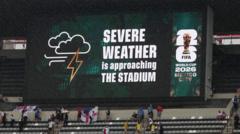
A sudden, severe thunderstorm forced tens of thousands of football fans to shelter in place at Mexico City’s Estadio Azteca just hours before a highly anticipated international friendly between Mexico and England. While stadium officials and local authorities managed to prevent immediate casualties by grounding spectators in concourses and interior corridors, the incident exposes a deeper, systemic vulnerability in modern sports infrastructure. High-altitude, open-air venues are increasingly unprepared for the volatile weather patterns colliding with packed international sporting calendars. This is no longer a matter of simple rain delays. It is a critical logistics and safety failure that the global sports industry refuses to take seriously.
The immediate reaction to the Azteca shutdown followed a predictable public relations script. Stadium management issued alerts, social media feeds updated in real time, and security personnel funneled fans away from the exposed stands as lightning cracked over Santa Ursula. On paper, the emergency protocol worked. The match was delayed, the crowd was contained, and the event eventually proceeded under slick, waterlogged conditions.
But looking at this event purely as a successful evacuation misses the point entirely. The reality on the ground revealed a chaotic scramble that highlighted how dangerously close major venues operate to the brink of disaster.
The Illusion of Stadium Safety under Climate Strain
Estadio Azteca is a monument to football history. Built in the 1960s, its colossal concrete bowl has hosted legendary World Cup moments. Yet, the architectural choices of the mid-20th century did not account for the sheer intensity of modern convective storms in the Valley of Mexico.
When a shelter-in-place order is issued for a crowd exceeding 80,000 people, the physical limitations of the venue become apparent immediately.
- Concourse Bottlenecks: Older stadiums feature narrow perimeter walkways. When thousands of fans pour downward simultaneously to escape lightning or hail, these spaces transform into high-pressure choke points.
- Drainage Failures: The pitch at Azteca possesses a famous drainage system, but the surrounding spectator infrastructure does not. Sub-level access points quickly turn into retention basins during flash deluges.
- Information Blackouts: Concrete monoliths act as natural Faraday cages. When thousands of users simultaneously try to access cellular networks to check weather updates or locate family members, local networks collapse.
Fans at the Mexico-England match reported a complete lack of audible directives in the lower concourses. They were left to rely on word-of-mouth rumors while lightning struck mere hundreds of yards away. This is the structural gap between an official safety plan and the lived reality of a stadium evacuation. Safety cannot exist solely on a supervisor's clipboard.
The Complicity of Governing Bodies
International football fixtures are multi-million dollar television broadcasts wrapped in a sporting event. The pressure to kick off on time is immense. Rights holders, corporate sponsors, and international federations exert massive financial leverage over local organizers. This pressure creates a dangerous incentive structure where delaying or canceling a match is viewed as an absolute financial catastrophe.
During the Azteca storm, the decision-making window was visibly warped by commercial obligations. Ground staff frantically swept water off the pitch while thunder shook the stadium structure. The protocol dictates that play must be suspended if lightning strikes within a specific radius, but the threshold for keeping fans exposed in the stands before that call is made remains terrifyingly vague.
We see this pattern repeating globally. Whether it is extreme heat at summer tournaments or flash flooding at historic venues, governing bodies consistently push the limits of safety to preserve broadcast windows. The fans in attendance are treated as a secondary consideration, a captive audience expected to endure hazardous conditions because they already paid for their tickets.
The Broken Blueprint of Modern Emergency Management
The concept of sheltering in place works excellently for a suburban school or a corporate office building. It fails when applied to a hyper-dense, emotionally charged sports crowd.
Consider the psychological mechanics of a stadium crowd during a severe weather event. Alcohol consumption is often high. Rival fan bases are packed into close quarters. When you force these opposing factions out of their designated seating zones and compress them into dark, humid concourses, you create a powder keg.
The risk of a crowd crush or a violent flashpoint increases exponentially every minute the shelter order remains active. During the delay before the Mexico-England match, minor altercations flared up near the concession areas simply due to overcrowding and frustration. Security forces, trained primarily to spot ticket fraud or pitch invaders, are rarely equipped to manage large-scale, static crowd dynamics in confined spaces for extended periods.
Reengineering the Gate Receipts
Fixing this vulnerability requires a complete overhaul of how stadium operators approach event day logistics. The industry can no longer view weather as an unpredictable act of God that absolves them of structural responsibility.
First, stadiums must invest in localized, predictive meteorological arrays that bypass regional public weather services. Waiting for a government agency to issue a warning means you are already thirty minutes behind the storm front. Venues need real-time data on lightning propagation vectors to begin phased evacuations of upper decks long before the first drop of rain hits the pitch.
Second, digital infrastructure must be hardened. Stadiums require dedicated, redundant emergency Wi-Fi networks that activate exclusively during crises. This allows operations to send targeted evacuation maps and clear instructions directly to spectators' smartphones, bypassing dead zones and broken public address systems.
Finally, the financial contracts governing these matches must change. There needs to be a standardized, legally binding framework that penalizes organizers who delay evacuation calls due to broadcast pressures. If federations face immediate, severe financial penalties for risking spectator safety, their risk tolerance will shift instantly.
The chaotic scenes at Estadio Azteca were a warning shot. The sports industry escaped a tragedy through sheer luck and the resilience of the local crowd, not because the system worked flawlessly. As weather patterns grow more volatile, relying on luck is a strategy that will eventually end in disaster on a global broadcast stage.