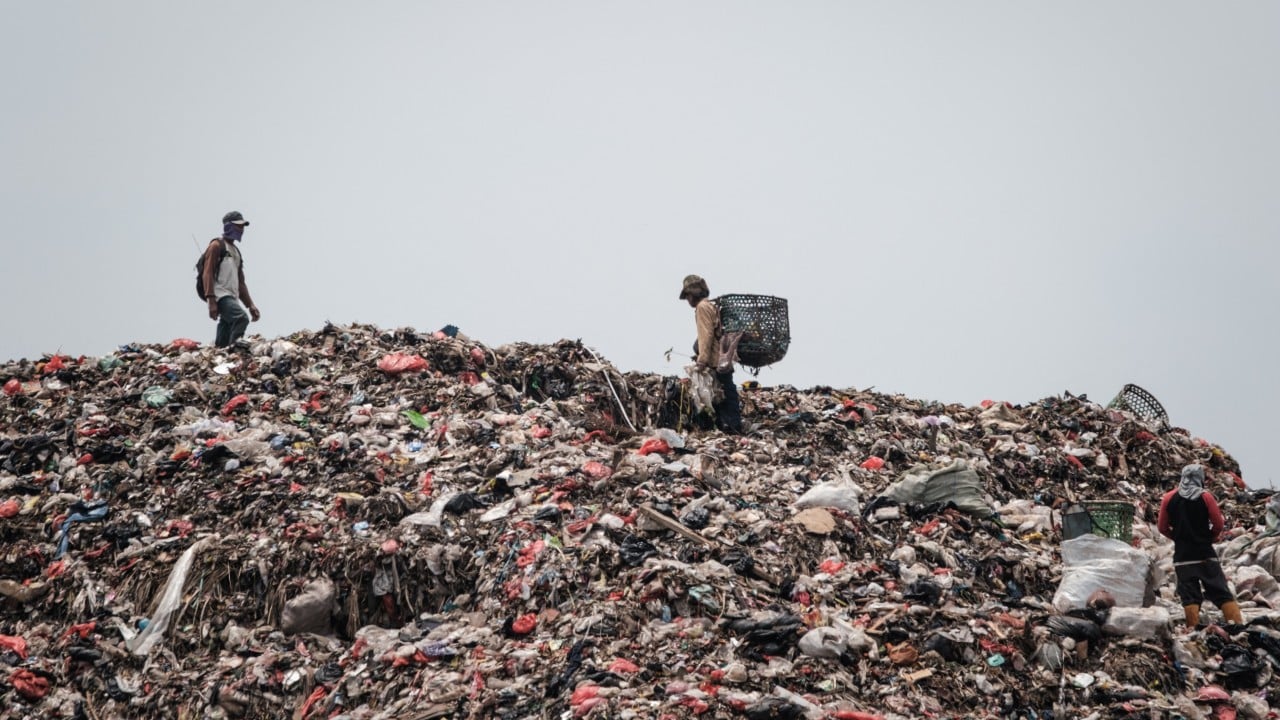
Indonesia’s commitment to Waste-to-Energy (WtE) as a primary solution for its urban waste crisis rests on a fundamental thermodynamic and economic fallacy: that municipal solid waste (MSW) is a uniform fuel source capable of yielding a net-positive energy return under current collection architectures. While the government targets 12 WtE plants under Presidential Regulation No. 35/2018, the transition from open dumping to thermal recovery is stalled by a failure to reconcile the high moisture content of tropical waste with the capital intensity of modern incineration. The crisis at the Bantar Gebang landfill, which receives over 7,500 tons of waste daily from Jakarta, serves as the terminal point of a system that prioritizes disposal volume over feedstock quality.
The Calorific Deficit: Why Tropical Waste Resists Combustion
The primary technical bottleneck in Indonesia’s WtE strategy is the Lower Heating Value (LHV) of its feedstock. For a waste-to-energy plant to operate autogenously—meaning it sustains combustion without continuous auxiliary fuel—the LHV must typically exceed 6–7 MJ/kg. Indonesian MSW, dominated by organic food waste (often comprising 50% to 60% of the total volume), frequently presents an LHV as low as 4 MJ/kg due to high moisture content, which often exceeds 55%.
The energy balance of an incinerator is governed by the relationship:
$$Q_{net} = Q_{combustion} - Q_{evaporation} - Q_{losses}$$
In the Indonesian context, the $Q_{evaporation}$ term is disproportionately high. The energy required to phase-change water into steam consumes a significant portion of the thermal energy released from plastic and paper fractions. This results in:
- Reduced Electrical Efficiency: A higher percentage of gross power is diverted to internal plant operations (parasitic load) to maintain furnace temperatures.
- Auxiliary Fuel Costs: Operators must often inject diesel or coal to stabilize the flame, transforming a "renewable" energy project into a hybrid fossil fuel plant with a higher carbon intensity per kilowatt-hour.
- Corrosion and Maintenance: High moisture leads to acidic flue gases, accelerating the degradation of boiler tubes and increasing the Levelized Cost of Energy (LCOE).
The Tipping Fee Paradox: Economic Misalignment in Municipal Budgeting
The financial viability of WtE depends on two revenue streams: electricity sales (the "off-take") and tipping fees paid by the municipality. In Indonesia, the gap between the cost of advanced thermal treatment and the willingness of local governments to pay for it creates a structural deficit.
The State Electricity Company (PLN) is mandated to purchase power from WtE projects at a feed-in tariff regulated by the Ministry of Energy and Mineral Resources. However, even with these subsidies, the projects require substantial tipping fees—often estimated at $25 to $40 per ton—to cover CAPEX and OPEX. Most Indonesian municipalities currently allocate budgets for waste management that reflect the costs of "collect and dump" operations, which are often less than $10 per ton.
This creates a Fiscal Solvency Gap:
- Limited Municipal Borrowing: Cities cannot secure the long-term debt required for billion-dollar facilities because their annual revenue cannot guarantee the tipping fee.
- Private Sector Hesitation: Without a sovereign guarantee or a robust "take-or-pay" agreement from the city, Public-Private Partnerships (PPP) face a high risk of default.
- The Bantar Gebang Dependency: Because upgrading to WtE is prohibitively expensive, municipalities continue to rely on landfill expansion, which is politically easier in the short term but physically impossible as sites reach capacity.
The Environmental Trade-off: Carbon Intensity and Fly Ash
The narrative that WtE is a "green" alternative to landfills ignores the shift in pollution media. While landfills emit methane ($CH_4$), which has a global warming potential over 25 times that of $CO_2$ over a 100-year period, incinerators convert carbon-based materials directly into $CO_2$ and concentrated hazardous waste.
A critical and often under-discussed output of WtE is Fly Ash and Bottom Ash (FABA). In Indonesia, FABA was recently reclassified to allow for easier reuse in construction materials, but the concentration of heavy metals (Lead, Cadmium, Mercury) and dioxins remains a public health risk if flue-gas cleaning systems are not operated at peak efficiency.
The "quick fix" logic fails because:
- Dioxin Control: Maintaining a constant temperature above 850°C for at least two seconds is required to destroy dioxins. When feedstock quality varies wildly (e.g., a sudden influx of wet organic waste during monsoon season), maintaining this thermal window becomes technically difficult and expensive.
- Carbon Accounting: If the plastic fraction is removed for recycling to improve the circular economy, the LHV of the remaining waste drops further. Conversely, if plastic is burned to sustain the fire, the plant becomes a de facto fossil fuel burner, undermining Indonesia's Nationally Determined Contributions (NDC) under the Paris Agreement.
The Infrastructure Lock-in: A Barrier to Circularity
Investing in large-scale incineration creates a 20-to-30-year "lock-in" effect. To remain financially viable, a WtE plant requires a guaranteed, steady stream of high-calorific waste. This creates a perverse incentive for municipalities to discourage recycling and waste reduction at the source.
Every ton of plastic diverted by a "Bank Sampah" (Waste Bank) or a formal recycling facility is a ton of fuel lost to the incinerator. This creates a Structural Conflict of Interest:
- The Scale Requirement: Most WtE technologies used in these projects are optimized for large volumes (e.g., 1,000+ tons per day).
- The Resource Hierarchy: In a truly circular economy, waste is managed through reduction, reuse, and recycling. WtE occupies the "recovery" tier, which should only receive non-recyclable residuals. If the "recovery" tier is over-capitalized, it "cannibalizes" the higher tiers of the waste hierarchy to ensure debt service.
Strategy for Resilience: De-risking the Waste Matrix
The resolution of the landfill crisis does not lie in a binary choice between incineration and dumping, but in a tiered logistical optimization. To move beyond the current impasse, the following structural adjustments are required:
1. Mandatory Feedstock Pre-treatment
The "quick fix" fails because it attempts to burn raw, unsorted waste. A resilient model requires the integration of Mechanical Biological Treatment (MBT). By processing waste through bio-drying or anaerobic digestion before it reaches the incinerator, the moisture content is reduced, and the organic fraction is converted into compost or biogas. This stabilizes the LHV of the remaining "Refuse Derived Fuel" (RDF), making the thermal conversion more efficient and predictable.
2. Regional Waste Aggregation
Individual cities in Indonesia often lack the waste volume and the budget to sustain a world-class WtE facility. The central government must facilitate regional waste management agreements where multiple regencies contribute to a single, high-capacity plant. This achieves economies of scale and spreads the fiscal burden of the tipping fee across a larger tax base.
3. Decoupling Energy Sales from Waste Disposal
The focus on "Energy" in Waste-to-Energy is often misplaced. The primary value of these plants is volume reduction (reducing waste volume by 90%), not power generation. Policy should shift toward a Service-First Model, where the plant is compensated primarily for the service of landfill diversion rather than for the megawatt-hours it produces. This reduces the pressure on the operator to burn high-value recyclables just to meet power quotas.
4. Integration of the Informal Sector
The "scavenger" economy in Indonesia is a highly efficient, though informal, sorting system. Rather than displacing these workers with automated plants, a masterclass strategy integrates them as the "pre-treatment" layer. By formalizing their role in removing low-energy/high-recyclability materials (like PET bottles and metals), the municipality improves the consistency of the WtE feedstock while maintaining social stability.
The terminal point of the current strategy is a series of underperforming, taxpayer-subsidized plants that fail to halt the growth of landfills. The shift must be toward RDF-focused decentralized processing—where waste is processed into dry fuel pellets at the source and sold to existing industrial users like cement kilns. This leverages existing combustion infrastructure (cement plants) without the need for massive new CAPEX, providing a faster, more modular solution to the Bantar Gebang crisis.