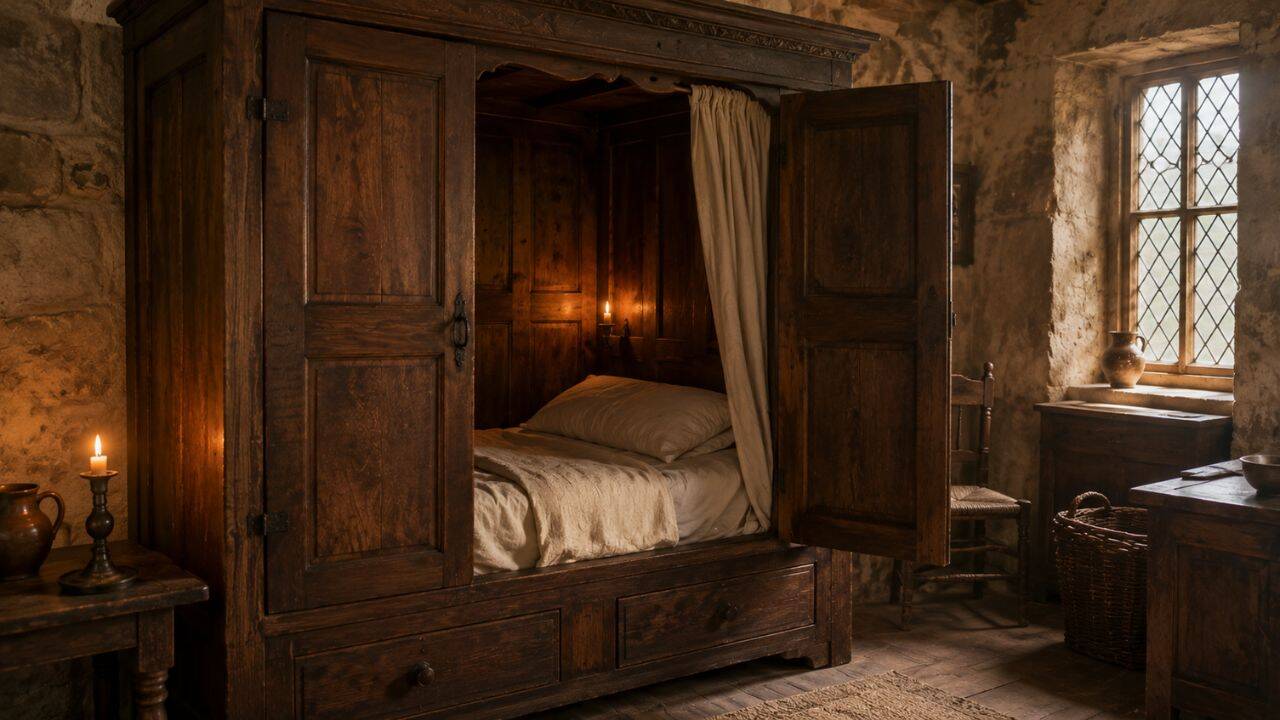
History bloggers love a good horror story. If you read the standard viral articles about medieval and early modern life, you will learn that our ancestors slept inside heavy, enclosed wooden cupboard beds—known as box beds or lits-clos—because they were terrified of wolves, ghosts, and the literal boogeyman.
They will tell you people slept upright because they thought lying flat would cause a stroke or let evil spirits enter their bodies. They will tell you it was a desperate, claustrophobic battle against a hostile world.
It is a fantastic narrative. It is also lazy history.
When you look at the actual architectural and social reality of rural Europe from the 14th to the 19th centuries, the "fear and superstition" angle completely falls apart. Box beds were not panic rooms. They were brilliant, multi-functional pieces of furniture that solved structural engineering problems that modern homeowners still struggle with today: privacy, thermal efficiency, and space optimization.
The Thermal Illusion: It Wasn't About the Ghosts, It Was About the Fire
The most common misconception is that Europeans created these wooden cocoons out of a psychological need for safety. Let’s look at the physics instead.
The average rural home in Brittany, Scotland, or the Netherlands for hundreds of years was a drafty, uninsulated structure. Central heating did not exist. Large open fireplaces were incredibly inefficient, throwing most of their heat straight up the chimney.
If you have ever tried to heat a high-ceilinged, stone-walled room with a single hearth, you know the heat stays within a few feet of the flames. The rest of the room is an icebox.
+-------------------------------------------------+
|                  Cold Air Zone                  |
|                                                 |
|   +-------------------+    +----------------+   |
|   |   Box Bed         |    |   Fireplace    |   |
|   |  [Trapped Heat]   |    |  (Escaping)    |   |
|   +-------------------+    +----------------+   |
+-------------------------------------------------+
A box bed is a micro-climate. By enclosing a mattress within four wooden walls and adding a sliding door or heavy curtain, you drastically reduce the volume of air that needs to be warmed. The sleeper’s own body heat warms the micro-space in minutes and keeps it comfortable through a freezing night.
To call this a product of medieval superstition ignores basic thermodynamics. It was a survival strategy disguised as furniture.
Why the "Sleeping Upright" Theory is Mostly Nonsense
You cannot browse a history forum without someone claiming that Europeans slept sitting up because they feared death or respiratory failure.
While it is true that people used more pillows and slept at a slighter incline than we do today, the idea that they sat bolt upright like passengers on a budget airline is a massive exaggeration.
- The Digestion Myth: People ate heavy, late meals. A slight elevation helps with acid reflux. This isn't superstition; it's basic anatomy.
- The Respiratory Reality: In a world where every indoor space was filled with smoke from open hearths, oil lamps, and tallow candles, respiratory issues were universal. Sleeping slightly propped up simply made it easier to breathe if you had chronic bronchitis or a lung infection.
The Great Privacy Deficit
We view the past through the lens of modern individualism. We expect everyone to have their own bedroom, or at least their own designated personal space.
In a traditional European farmhouse, the "longhouse" or single-room layout was standard. The entire family, along with seasonal laborers and sometimes livestock, lived, cooked, and interacted in one shared space.
+-------------------------------------------------------------+
|                                                             |
|   Living/Cooking Area        Shared Sleeping Area           |
|                              +---------+   +---------+      |
|                              | Box Bed |   | Box Bed |      |
|                              +---------+   +---------+      |
|                                                             |
+-------------------------------------------------------------+
The box bed was the only wall available. It was modular architecture. Closing the wooden doors did not just block out the cold; it blocked out the rest of the commune. It gave married couples privacy, protected infants from the chaos of a working household, and offered a modicum of dignity in a world where personal space was a luxury.
If you think people built these because they were scared of wolves wandering into their bedrooms, you have never lived in a house with ten other people and zero internal walls.
The Ultimate Space-Saving Life Hack
The modern design community loses its mind over "micro-apartments" in Tokyo or New York that feature hidden storage and fold-down furniture. They act like they invented the concept.
The medieval box bed was doing this five hundred years ago.
These units were rarely just a place to sleep. They were integrated storage systems. The base of the bed often featured deep drawers for linens. The top of the bed—the roof of the cupboard—was used to store dry goods, luggage, or tools out of the way of damp floors.
In many Breton cottages, box beds were stacked on top of each other, creating a literal bunk-bed wall that maximized every square inch of vertical space.
The bench used to climb into the bed was simultaneously a storage chest for clothes and the seating for the dining table during the day. It was an tightly integrated ecosystem of domestic utility.
The Decline: Why We Traded Function for Fashion
If the box bed was so superior, why did it vanish?
It wasn't because people suddenly realized ghosts weren't real. It changed because the architecture of the home changed.
When multi-room houses became affordable for the working class, the need for a micro-climate and a privacy wall disappeared. Separate bedrooms meant you could have an open bed without the entire village watching you sleep. Improved ventilation and iron stoves meant you could warm a room without suffocating on wood smoke.
The box bed was stigmatized. It became a symbol of rural poverty, backwardness, and the "old ways."
But as we look at rising heating costs, shrinking urban apartment sizes, and the absolute disaster of open-plan living spaces that offer zero privacy, the box bed starts to look less like a medieval relic and more like a massive missed opportunity.
Stop looking at history through a lens of intellectual superiority. Our ancestors weren't stupid, hiding in cupboards from imaginary monsters. They were practical, efficient designers dealing with harsh climates and crowded spaces.
If you want to save money on your heating bill this winter, you shouldn't buy a smart thermostat. You should build a box bed.