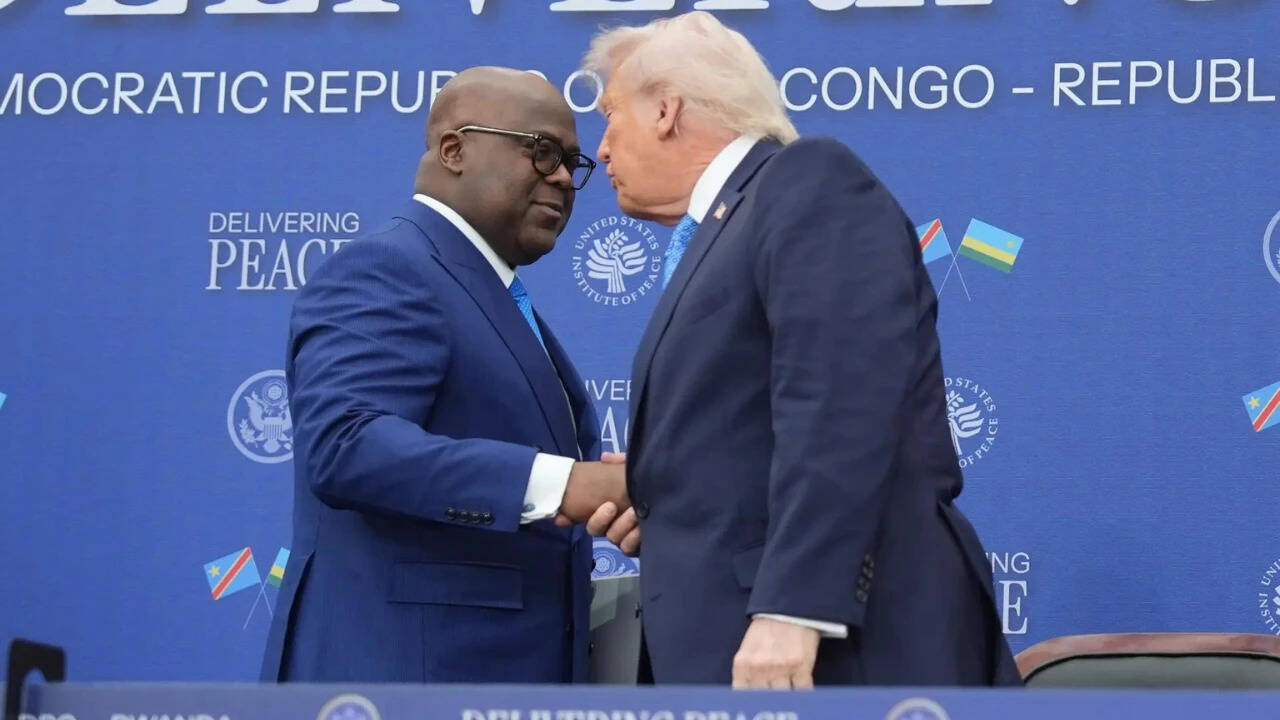
The Democratic Republic of Congo (DRC) has officially joined a growing network of African nations serving as a release valve for the Trump administration’s mass deportation campaign. Under a deal confirmed by Kinshasa on Sunday, the central African nation will begin accepting "third-country nationals"—migrants who are not Congolese—deported from the United States as early as this month. The agreement is framed by both governments as a humanitarian and logistical necessity, but the fine print suggests a far more transactional reality. Washington is effectively trading diplomatic cover and mineral access for the right to offload thousands of people into one of the world's most volatile regions.
This is not a standard repatriation agreement. While most international deportation treaties involve a country taking back its own citizens, the "Congo Deal" belongs to a new class of third-country arrangements. It mirrors previous agreements struck with Eswatini, Ghana, and Rwanda since 2025. In these deals, the receiving nation is paid to act as a processing hub or a permanent home for migrants who have no ancestral or legal connection to the land.
The Mechanics of the Exchange
According to statements from the Congolese Ministry of Communications, the U.S. government will fully fund the logistics, housing, and administrative costs. No financial burden will fall on the Congolese treasury. Facilities have already been prepared near the capital, Kinshasa, to receive the first waves of deportees.
The immediate question is why a nation already hosting millions of internally displaced persons and grappling with a decades-long conflict in its eastern provinces would volunteer for this. The answer lies in a broader, quieter "Strategic Partnership Agreement" signed in December 2025.
That agreement, currently facing a constitutional challenge in Congolese courts, links migration cooperation to two of Kinshasa’s most desperate needs:
- Security Mediation: The Trump administration has positioned itself as the primary mediator between the DRC and Rwanda regarding the M23 rebel insurgency.
- Mineral Investment: The U.S. has secured preferential access to Congolese reserves of cobalt, copper, and lithium—minerals essential for the global tech and defense industries.
By accepting deportees, President Félix Tshisekedi’s government is buying goodwill in Washington at a time when his administration is under fire for its inability to secure the East. It is a security-for-minerals-for-migrants bargain. The Congolese government insists that "no automatic transfer is planned" and that each case will undergo an "individual review," but critics argue this is a thin legal veneer.
Legal Limbo and Human Rights
The legal basis for sending a Venezuelan or an Ethiopian migrant to Kinshasa is shaky at best. Under U.S. law, the government must provide "reliable assurances" that deportees will not be tortured or persecuted in the receiving country. However, the DRC’s human rights record is frequently cited by the U.S. State Department itself as problematic.
Many of those slated for transport to Congo have existing "protection orders" from U.S. immigration judges. These orders are intended to prevent their return to their home countries because of a high risk of death or torture. By sending them to a third country like the DRC, the administration is bypassing the spirit of these judicial protections. The migrants aren't being returned to "danger" in their homeland; they are being sent to a different kind of uncertainty in a foreign state.
The Senate Foreign Relations Committee recently revealed that the administration has already spent $40 million to move roughly 300 migrants to third-country partners. The cost per person is astronomical, yet the pace of these deals is accelerating. The DRC is the eighth African nation to sign on.
Infrastructure of Control
The facilities near Kinshasa are described as "temporary reception centers." In practice, they often function as detention zones. For the deportees, the arrival in Kinshasa marks the beginning of a profound legal vacuum. They are not Congolese citizens, they are not U.S. residents, and they cannot return to their original homes.
Kinshasa retains full control over their stay, their oversight, and their eventual removal. If a deportee commits a crime or simply becomes too expensive to house, the Congolese government has the right to expel them. To where? That remains the unanswered question that haunts every line of these diplomatic notes.
The "Washington Accord," as the broader regional deal is known, has already seen the U.S. impose symbolic sanctions on Rwanda to appease Kinshasa. These sanctions were the lubricant that made the deportation deal slide through the Congolese legislature. It is a high-stakes game of geopolitical chess where the pawns are human beings and the prize is the cobalt that powers the 21st century.
The Domestic Pressure Cooker
Within the U.S., the push for these deals is driven by a domestic mandate to clear backlogs at any cost. With over 540,000 deportations carried out by ICE since early 2025, the administration is running out of countries willing to accept their own people. Third-country deals provide a workaround for "recalcitrant" nations that refuse to cooperate with U.S. removal flights.
If a country like Venezuela or China refuses to take back its citizens, the U.S. simply finds a willing partner elsewhere. Congo, with its desperate need for U.S. military support and investment, is the perfect candidate.
The "temporary" nature of the Congolese centers is also a tactical choice. It allows the administration to claim these are not "safe third country" agreements in the traditional sense, which would require more rigorous legal standards and access to a full asylum procedure within the DRC. Instead, they are being treated as "deportation bridge" agreements—a place to put people while the rest of the world figures out what to do with them.
The arrival of the first flights this month will test the durability of this arrangement. For the Trump administration, it is a victory for the "America First" agenda. For the Congolese government, it is a necessary evil to keep the mineral-hungry Americans on their side of the border. For the migrants, it is the start of an exile in a land they do not know, paid for by a country that no longer wants them.
The reality of 2026 is that geography is no longer a barrier to deportation; it is merely a line item in a mineral trade negotiation. Expect more flags to be added to this map as the hunt for "willing partners" continues across the Global South.
Kinshasa has set the price. Washington has paid it. The flights are fueled and ready.