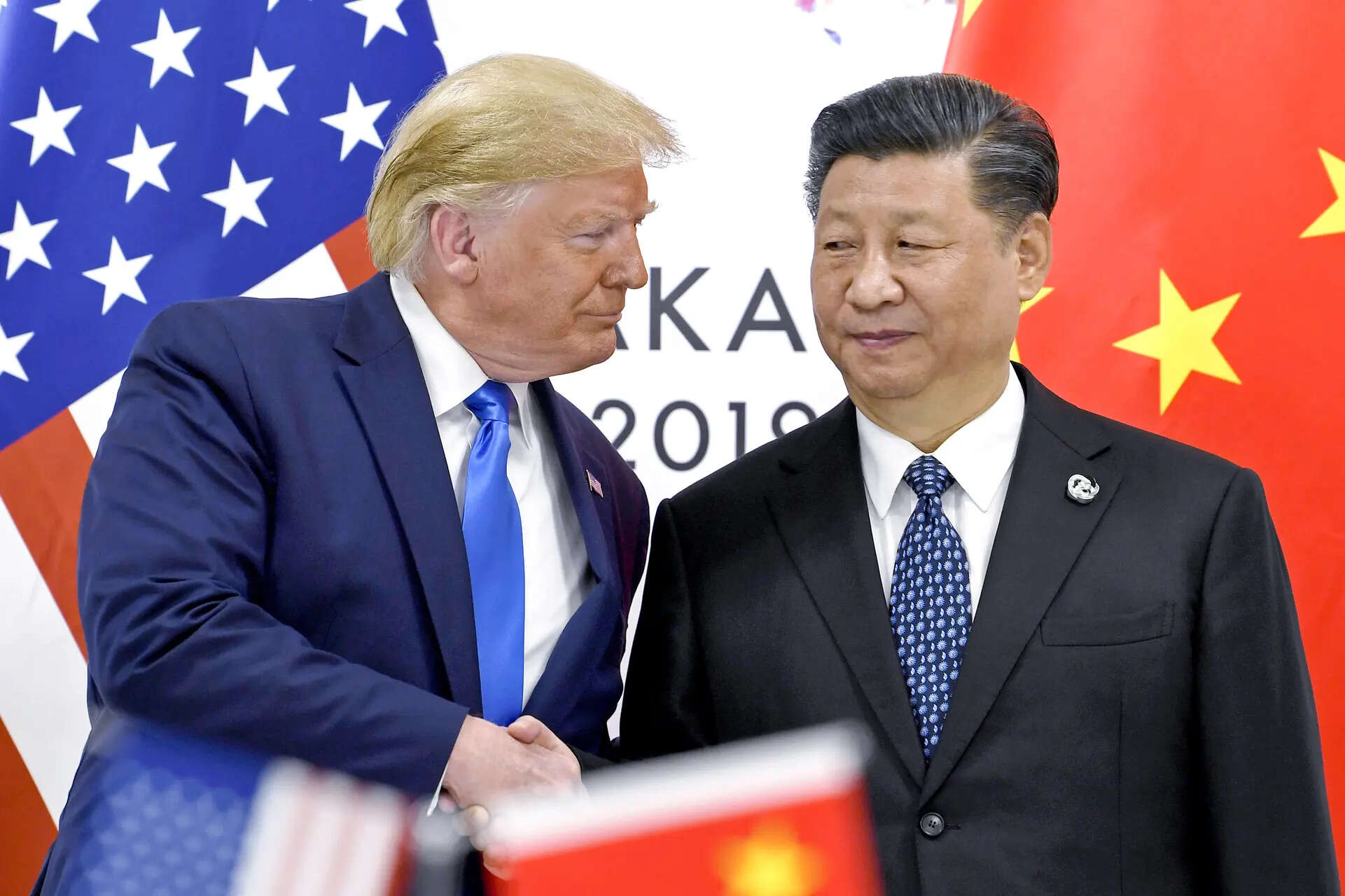
The collision between Donald Trump and Xi Jinping is not a standard trade dispute or a classic diplomatic friction. It is a fundamental friction between two incompatible operating systems for the twenty-first century. One is a chaotic, transactional populism that views every interaction as a zero-sum negotiation. The other is a rigid, civilizational project aimed at total domestic control and global technological dominance. To understand the current breakdown in international relations, one must look past the tariffs and the rhetoric to the internal logic driving both men. They are both convinced that the previous era of global cooperation was a scam, though they disagree entirely on who was being cheated.
The Transactional Instinct vs The Civilizational Mandate
Donald Trump views the world through the lens of a balance sheet. To him, alliances are subscription services where the U.S. is overpaying for the premium tier while everyone else leaches off the basic plan. This "Don Tzu" approach treats geopolitical strategy as a series of tactical skirmishes. There is no long-term ideological end state, only the next deal, the next headline, and the immediate correction of a perceived trade deficit.
Xi Jinping operates on a different timeline entirely. As the "philosopher king" of the Chinese Communist Party (CCP), his worldview is rooted in the "Great Rejuvenation of the Chinese Nation." While Trump wants to win today's news cycle, Xi wants to win the century. Xi’s philosophy, often codified as "Xi Jinping Thought," integrates Marxism-Leninism with a neo-Confucian emphasis on order and hierarchy. He isn't looking for a better deal; he is looking to rewrite the rules of the house so that the house always wins.
The friction arises because Xi’s long-term planning requires a predictable, stable international environment, while Trump’s power is derived from unpredictability. When a man who views stability as a prerequisite for power meets a man who views disruption as his primary weapon, the result is a permanent state of high-intensity friction.
The Weaponization of the Supply Chain
For decades, the global supply chain was built on the assumption that efficiency was the only metric that mattered. Companies moved production to wherever it was cheapest, usually China. Trump broke that consensus by arguing that efficiency was a trap. By imposing tariffs, he forced a realization that dependence on a single geopolitical rival for essential goods—from semiconductors to pharmaceutical ingredients—is a massive national security vulnerability.
Xi Jinping reached the same conclusion from the opposite direction. He saw how the U.S. could use the "chokehold" of financial systems and high-end chip technology to cripple Chinese firms like Huawei. This led to the "Dual Circulation" strategy. This policy aims to make China self-reliant in core technologies while simultaneously making the rest of the world more dependent on Chinese manufacturing.
This is the "how" of the conflict. It is a race to decouple without collapsing. Trump’s method is a blunt instrument—tariffs and sanctions designed to shock the system into moving. Xi’s method is a surgical, state-funded infusion of capital into industries like artificial intelligence and green energy. The goal for both is the same: strategic autonomy. They both want to be the ones holding the leash.
The Silicon Iron Curtain
Technology has become the primary battlefield where these two worldviews manifest. It is no longer about who sells more sneakers; it is about who owns the data and the infrastructure that carries it.
- The U.S. Model: Under Trump, the focus shifted toward aggressive restriction. The "Clean Network" initiative was an attempt to build a digital alliance that excluded Chinese hardware. This was based on the belief that Chinese tech is inherently an extension of the CCP’s surveillance apparatus.
- The Chinese Model: Xi has presided over the construction of the most sophisticated domestic surveillance state in history. Through the "Great Firewall" and the integration of social credit systems, he has demonstrated that technology can be used to enforce ideological purity. Now, he is exporting this model via the "Digital Silk Road."
We are seeing the emergence of two distinct internets. One is relatively open but increasingly fragmented by nationalist regulations. The other is a closed loop, managed by a central authority that views information as a threat to be managed rather than a resource to be shared. The divergence is irreversible.
Control vs Chaos as a Governance Tool
The most striking difference lies in how each leader handles internal dissent. For Xi, any form of chaos is a sign of weakness. He has spent his tenure purging "tigers and flies"—corrupt officials and political rivals—to ensure the Party is a monolithic entity. His crackdown on Hong Kong and the tightening of control over private tech giants like Alibaba are expressions of this need for absolute order. He believes that for China to survive, the Party must be the brain, the nervous system, and the heart of the nation.
Trump, conversely, uses chaos as a political propellant. He thrives on the friction between different branches of government, the media, and even within his own cabinet. This internal turbulence is baffling to the Beijing leadership. They view it as a sign of a declining empire in its death throes. However, this very volatility makes the U.S. difficult to map or predict. In a traditional chess match, Xi is a grandmaster. Trump, however, is liable to flip the table and start an entirely different game while the clock is still running.
The Myth of the Grand Bargain
Many analysts still hold out hope for a "Grand Bargain"—a massive, all-encompassing treaty that settles the South China Sea, trade imbalances, and intellectual property theft in one go. This is a fantasy.
Xi cannot concede on intellectual property or state subsidies because those are the engines of China's survival. Trump cannot concede on tariffs or trade restrictions because those are the core promises to his base. There is no middle ground when both sides view the other's fundamental survival strategy as an existential threat.
The reality is a managed decline of the relationship. We are entering an era of "restricted engagement." This means that while some trade will continue out of necessity, the trust that underpinned the last thirty years of globalization has evaporated. Businesses are being forced to choose sides. You are either in the dollar-clearing system or you are in the yuan-clearing system. You are either building on U.S. clouds or Chinese ones.
The Proxy Battle for the Global South
As the U.S. and China turn inward or focus on each other, the real struggle for influence is happening in Southeast Asia, Africa, and Latin America. Xi’s "Belt and Road Initiative" (BRI) is a massive infrastructure play that trades debt and construction for long-term political loyalty. It is a "kingly" move, projecting power through patronage.
Trump’s approach to these regions is more skeptical. He views foreign aid as a "bad deal" and prefers bilateral agreements that offer immediate benefits to the U.S. economy. This leaves a vacuum that China is more than happy to fill. However, the BRI is beginning to show cracks. Debt-trap diplomacy is creating resentment in countries that realize they have traded their sovereignty for a bridge they can't afford to maintain.
The contest here is between a visible, heavy-handed presence (China) and a retreating, conditional one (U.S.). Neither is particularly attractive to developing nations, but they are the only options on the menu.
The End of the Post-Cold War Illusion
The fundamental mistake made by Western observers for decades was the belief that as China grew wealthier, it would inevitably become more like the West. Xi Jinping has killed that idea. He has proven that a nation can be a global economic powerhouse while remaining a closed, authoritarian society.
Trump, for his part, has killed the idea that the U.S. will always be the guarantor of the global status quo. He has signaled that the U.S. is tired of being the "world’s policeman" if the pay doesn't match the risk.
These are not temporary shifts. Even if the individuals leave the stage, the forces they have unleashed—economic nationalism in the West and neo-authoritarianism in the East—are now the dominant features of the landscape. We are not heading toward a new Cold War; we are already in it. The only difference is that this time, the two protagonists are so deeply entwined that trying to separate them is causing a systemic shock to every economy on the planet.
Practical Realities for Global Markets
For the executive or the investor, the takeaway is clear. The era of "Globalism 1.0" is over. Strategy must now account for geopolitical risk as a primary variable, not a footnote.
- Redundancy over Efficiency: If your supply chain runs through a single point of failure in the Taiwan Strait, you don't have a supply chain; you have a gamble.
- Technological Sovereignty: Expect more "In China, for China" mandates. Foreign firms will likely have to fork their operations entirely, creating separate entities that comply with mutually exclusive regulations.
- The Rise of Non-Aligned Hubs: Countries like Vietnam, India, and Mexico will become the "neutral ground" where the two systems attempt to interface, though even they will face increasing pressure to pick a camp.
The friction between the "Don Tzu" mindset and the "Philosopher King" is the defining feature of our age. It is a battle of wills between a man who wants to win the deal and a man who wants to win the future. In this environment, the only certainty is that the middle ground has disappeared.
Move your assets accordingly.