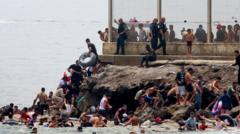
Every time a few hundred desperate swimmers trade the Moroccan coastline for the rocky shores of Ceuta, European media outlets scramble for the same tired vocabulary. We get the breathless reports of emergencies, the aerial shots of coast guard cutters, and the hand-wringing editorials about overwhelmed local infrastructure. The lazy consensus says this is an invasion, a security emergency, or a humanitarian disaster unfolding on the edges of fortress Europe.
It is none of those things.
Ceuta is not a crisis of migration. It is an indictment of institutional friction. When a government builds an impenetrable wall right next to an economy starved of mobility, human ingenuity simply routes around the concrete. I have spent years tracking cross-border economics and political geography, and I can tell you flatly that every single barrier erected without addressing the underlying wage differential is nothing more than an expensive speed bump.
The Geography of Economic Desperation
Let us look at the fundamental physics of the situation. Ceuta and Melilla are European Union territory physically attached to the North African landmass. Look at a map for two seconds and you understand why the border works as a magnet rather than a deterrent. On one side, you have a rigid European labor market with high minimum standards, strict bureaucratic entry visas, and virtually zero legal pathways for low-skilled cyclical work. On the other side, you have young, capable Moroccan workers sitting across a fence that is literally visible from their doorsteps, watching a developed economy function just yards away.
When the cost of staying put is economic stagnation and the perceived reward of crossing is immediate access to the Schengen zone, swimming around a breakwater ceases to be a reckless gamble. It becomes rational behavior.
The conventional coverage treats these arrivals as an unexpected shock wave. That is nonsense. These movements operate with the predictability of the tide. They accelerate when diplomatic ties between Madrid and Rabat sour, and they slow down when police cooperation intensifies. The flow is not an uncontrollable natural disaster; it is a valve turned by political negotiations and economic desperation.
Why More Concrete Solves Nothing
Governments love walls because walls are photogenic. They look decisive on the evening news. They allow politicians to stand on concrete platforms, point at the horizon, and proclaim that they are protecting the homeland.
It is entirely performative.
Economists who study border security call this the diversion effect. When you harden one entry point, you do not stop the flow; you merely change the vector. You push people toward more dangerous maritime routes, higher smuggling fees, and more predatory criminal networks. Every euro spent on razor wire and biometric surveillance gear in Ceuta is a euro wasted on treating the symptom while ignoring the disease.
Imagine a scenario where the European Union treated regional proximity with actual economic integration instead of border policing. What if seasonal labor permits were as frictionless as a commuter train pass? The entire smuggling economy would collapse overnight. People do not risk hypothermia in the Strait of Gibraltar because they love swimming in cold water; they do it because the legal door is welded shut.
The uncomfortable truth is that European industry quietly relies on undocumented labor to prop up agriculture, construction, and service sectors. The border exists in its current dysfunctional state because it satisfies two opposing political demands: the electorate gets the theater of strict enforcement, while domestic employers get a hyper-flexible, cheap labor pool that has zero legal recourse against exploitation.
The Bureaucratic Blind Spot
Brussels operates under the delusion that borders can be sealed by administrative decree. This ignores every lesson of modern logistics. Human capital flows toward demand with the same relentless pressure as water finding a crack in a dam.
When you criminalize movement without creating functional legal channels, you do not stop the movement. You simply hand the market over to human traffickers. You turn desperate job seekers into illegalized cargo.
The mainstream press wants you to view the young men and women washing up on the beaches of Ceuta as foreign elements threatening a domestic sanctuary. Reverse that perspective. They are rational economic agents responding to a profound structural imbalance created by trade barriers and immigration quotas that belong in the nineteenth century, not the twenty-first.
If European policymakers actually wanted to stop these dramatic swims, they would stop funding more fences and start negotiating realistic, market-driven labor mobility agreements that allow people to cross legally, work, pay taxes, and go home.
Until then, expect more video footage of wet clothes, emergency blankets, and politicians acting surprised by the predictable consequences of their own bad design.
Stop funding the wall. Fix the market.