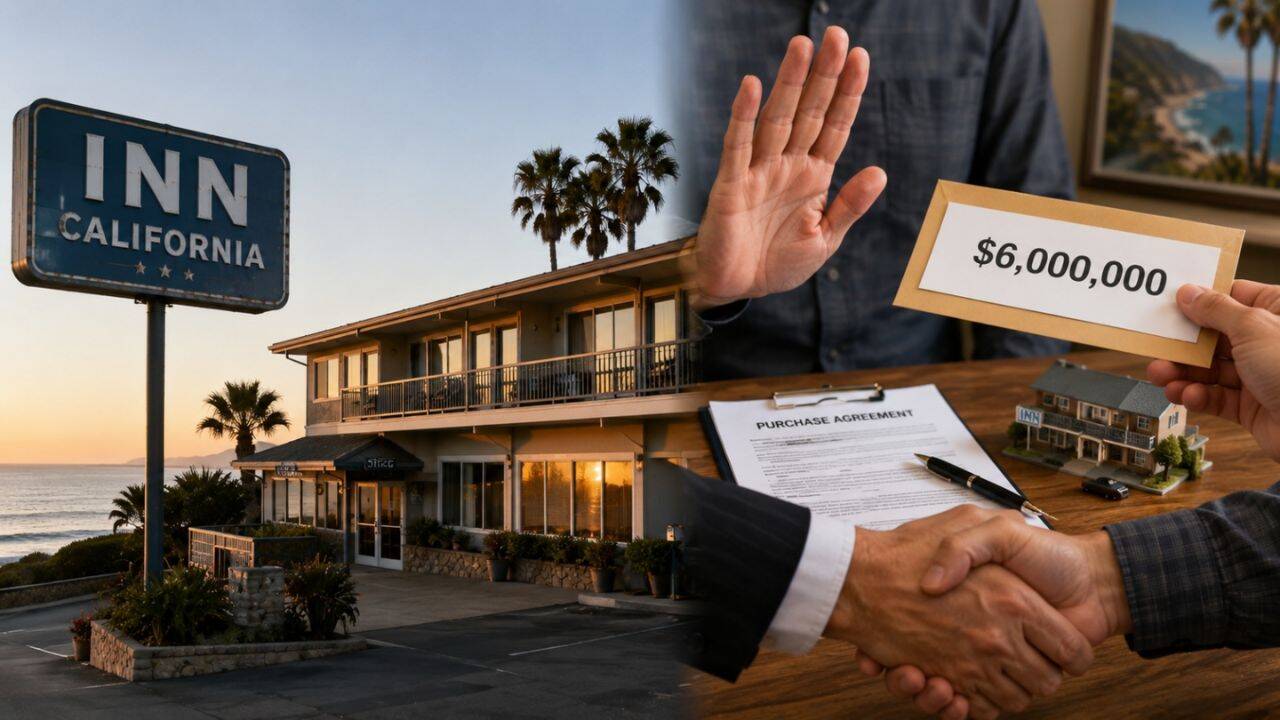
When a California property owner turns down a six-million-dollar buyout, seasoned brokers usually smell delusion. Most lowball or fair-market refusals end in foreclosure, crushed leverage, or a quiet settlement pennies on the dollar after legal fees drain the bank accounts of stubborn heirs. But sometimes, holding out against a corporate behemoth yields a payday that forces an entire industry to rewrite its valuation models.
In 2011, a stubborn property transaction involving a California hotel shattered conventional wisdom when an initial six million dollar offer was rejected out of hand, eventually scaling to a staggering 16.25 million dollars. This dramatic escalation was not an accident of luck. It was a masterclass in strategic positioning, zoning leverage, and weaponized patience against deep-pocketed developers who desperately needed a specific footprint to make their master plans viable.
To understand how a modest asset more than doubles its valuation under duress, you have to look past the headlines and examine the brutal mechanics of urban assembly. Real estate development is a game of absolute control. A developer piecing together a city block faces a binary outcome. Either they acquire every single parcel to secure financing and permits, or the entire project collapses under the weight of holdouts. A single stubborn owner acts as a microscopic grain of sand that can completely lock up a multi-million-dollar machine.
The Anatomy of a Lowball Opening Bid
Institutional buyers never lead with their maximum capacity. When corporate acquisition teams targeted the California hotel site in the early 2010s, they deployed a classic anchoring strategy. Six million dollars sounds like a generational fortune to the average observer. Against the backdrop of the surrounding land assembly, however, it was a discount price designed to test the resolve of owners who might have been fatigued by operational costs.
Commercial real estate operates on projected yield, not sentimental value. The buyers calculated the future revenue of a consolidated luxury or commercial expansion, factored in the cost of construction, and worked backward to determine what they could afford to pay for the existing structure. Their math assumed the owners would take the easy exit.
They miscalculated the intrinsic value of strategic geography.
Properties positioned squarely in the path of municipal expansion hold asymmetric power. The hotel was not just a collection of rooms and a parking lot. It was the linchpin of a much larger puzzle. Without it, the surrounding parcels assembled by the developer were functionally landlocked or architecturally compromised.
Weaponizing the Timeline
Time is the ultimate weapon in high-stakes property negotiations. Developers operate on strict debt schedules, construction loans, and municipal approval windows. Every month a project sits stagnant due to an unacquired parcel, interest payments bleed millions of dollars from the balance sheet.
The owners of the California hotel understood this pressure point implicitly. By refusing the initial six million dollar proposal, they shifted the burden of time onto the buyer.
An immediate rejection signals financial stability. It tells the acquiring entity that the seller is not facing imminent bankruptcy, tax liens, or operational distress. When a seller can afford to wait, the psychology of the negotiation flips. The corporate buyer stops viewing the acquisition as a routine purchase and starts viewing it as an emergency containment operation.
As years passed and regional property values shifted upward following the post-2008 economic recovery, the baseline value of the land naturally appreciated. But organic appreciation alone does not account for a jump from six million to over sixteen million dollars. That delta represents pure extortion leverage. The developer was bidding against their own mounting holding costs, public relations exposure, and the looming expiration of conditional use permits.
The Cost of Eminent Domain Fantasies
Many observers assume large developers can simply rely on municipal governments to use eminent domain to sweep stubborn property owners aside. This is a common misunderstanding of urban development law.
Eminent domain requires a strict finding of public use. Clearing land for a private hotel, commercial plaza, or luxury mixed-use high-rise rarely clears the legal threshold required to justify state seizure without inviting catastrophic litigation. Even when municipalities attempt public-private partnerships to condemn holdout properties, the legal battles can drag on for half a decade.
The developers eyeing the California hotel knew that litigation would cost more and take longer than simply inflating their purchase offer. Public inquiries, environmental impact report challenges, and City Council hearings become weapons of mass destruction for corporate timelines.
Every council meeting discussing the project kept the spotlight on the developer's inability to secure the final piece of the puzzle. Investors hate uncertainty. By refusing to fold, the hotel owners manufactured a crisis of confidence in the boardroom of the buying corporation.
Decoding the Final Figure
When the transaction finally closed at 16.25 million dollars, industry analysts scrambled to justify the metrics. Per square foot, the price defied every comparable sale in the immediate district.
The secret lies in residual land value analysis. To the buyer, the 16.25 million dollar price tag was not the cost of an old hotel. It was the admission fee required to unlock hundreds of millions of dollars in subsequent development value. If paying an extra ten million dollars guarantees the viability of a project grossing one hundred million dollars, the math suddenly favors the holdout.
Corporate finance departments hate admitting when they have been squeezed. They disguise these payouts as "assembly premiums" or "strategic asset integration costs." In reality, it is ransom paid to a property owner who simply refused to blink first.
The Dangerous Illusion of Replication
For every California hotel story that ends in a historic windfall, a thousand others end in financial ruin. Amateurs often look at these rare anomalies and assume that stubbornness is a foolproof investment strategy.
It is not.
Most holdouts misread their own leverage. They confuse sentimentality with strategic necessity. If a developer can route around your property, redesign their blueprints, or simply build over your objections without crippling the project, holding out transforms you from a shrewd negotiator into an isolated eccentric sitting on a depreciating asset.
The hotel owners in 2011 possessed a rare trifecta. They owned absolute geographic centrality, they maintained clean financial books that allowed them to absorb years of holding costs, and they faced a buyer whose entire financial architecture hinged on total land assembly.
Without all three elements working in tandem, the six-million-dollar offer would have been the high-water mark of their financial existence. Instead, their refusal became a cautionary tale for corporate dealmakers and a masterclass in modern asset leverage.
The Permanent Shift in Urban Acquisition
The fallout from the 16.25 million dollar payout permanently altered how acquisition scouts operate along the West Coast. Corporate buyers no longer enter negotiations assuming mom-and-pop owners will fold under the pressure of flashing corporate capital.
Due diligence now includes exhaustive psychological profiles of target property owners, tracking their debt structures, generational succession plans, and historical litigation tendencies long before the opening bid is drafted. The goal is to identify potential holdouts before they realize their own tactical superiority.
When a multi-billion-dollar enterprise meets an immovable object, the checkbook is the only tool left that speaks loudly enough to break the deadlock.
The Final Leverage Point
Real estate is rarely won by the entity with the most capital. It is almost always won by the entity that cares the least about immediate outcomes. While the developer worried about quarterly earnings reports and construction timelines, the hotel owners simply maintained their position, knowing that geography was destiny.
In the high-stakes theater of modern land assembly, the most dangerous person in the room is the one who is completely comfortable walking away with nothing, because that indifference makes them impossible to defeat.