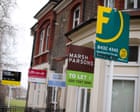
After years of relentless upward pressure, the private rental market in Great Britain has finally hit a ceiling. For the first time since 2017, monthly asking rents have stalled, remaining flat at an average of £1,344 outside London. This is not a sign of a sudden surplus of housing or a newfound altruism among landlords. It is the sound of an engine seizing up because it has run out of oil. The British renter has been squeezed until there is nothing left to give, and the market is now forced to reckon with the hard limits of affordability.
While headlines might frame this as a victory for tenants, the reality is far more complex and significantly more grim. This stagnation marks the transition from a period of aggressive growth to a volatile stalemate. Landlords are facing their own set of pressures from high interest rates and tax changes, while tenants are trapped in a cycle of stagnant wages and a chronic lack of available stock. The plateau is not a solution. It is a symptom of a broken system that has finally reached its breaking point.
The Illusion of Relief
On the surface, 0% growth looks like a win. If you have spent the last seven years watching your largest monthly expense climb by 5%, 8%, or even 10% annually, a month of silence feels like a reprieve. But look closer at the data. In London, where the crisis is most acute, asking rents actually dipped by a marginal 0.3%. This is less a correction and more a desperate gasp for air.
The plateau exists because we have reached the absolute limit of what a household income can sustain. When 40% or 50% of take-home pay is already dedicated to a landlord, there is no room for further increases, regardless of how much demand outweighs supply. We are seeing a "hard ceiling" effect where the economic reality of the tenant’s bank account has finally overruled the speculative desires of the property market.
Why the Surge Stopped Now
To understand why 2024 has become the year the music stopped, we have to look at the intersection of three specific pressures.
First, the mortgage shock has finally filtered through the entire system. Landlords who were on cheap, interest-only trackers or five-year fixed deals from the pre-2022 era have seen their costs double or triple. Initially, they attempted to pass every penny of this increase onto the tenant. For two years, they succeeded. But as of this quarter, the "pass-through" mechanism has failed. Tenants simply cannot pay more, leaving many landlords with properties that are no longer cash-flow positive.
Second, we are seeing a shift in the "renter profile." The massive post-pandemic migration back to city centers has peaked. The frantic bidding wars, where tenants offered six months of rent upfront or £200 over the asking price, have cooled. This isn't because people don't want to live in cities, but because the demographic most likely to rent—young professionals and service workers—has been effectively priced out of the very concept of "extra" money.
The Inventory Paradox
Supply remains the ghost in the machine. While the number of available rental properties has increased slightly compared to the absolute lows of 2022, it remains roughly 25% below 2019 levels. In a functional market, low supply plus high demand equals rising prices. The fact that prices are staying flat despite this scarcity is the clearest indicator of an affordability crisis.
When supply is this low and prices still won't move, it means the product has become a luxury good that the primary consumer can no longer afford. We are witnessing the "premiumization" of basic shelter.
The Hidden Exodus of Small Landlords
The "accidental landlord" and the individual with a two-property portfolio are disappearing. They are being replaced, albeit slowly, by institutional "Build-to-Rent" (BTR) schemes. This shift is fundamental to why the rental market feels different today than it did a decade ago.
Small-scale landlords are fleeing for several reasons:
- The Section 24 Tax Trap: Investors can no longer deduct mortgage interest from their rental income before paying tax, making the business model untenable for many.
- Regulatory Fatigue: Incoming energy efficiency requirements (EPC ratings) and the abolition of "no-fault" evictions have made the sector feel like a minefield rather than a passive investment.
- Higher Returns Elsewhere: With savings accounts and gilts offering decent yields for zero effort, the stress of a leaking pipe at 3:00 AM for a 3% net return no longer makes sense.
This exodus creates a "lumpy" market. When an individual landlord sells, that house often leaves the rental sector entirely to be bought by an owner-occupier. This further constricts the rental pool, even as corporate blocks rise in the background. The problem? Corporate landlords rarely lower rents. They would rather have a 5% vacancy rate than lower the "market rate" of their building, as doing so would devalue their entire asset in the eyes of their shareholders.
The Geography of Stagnation
The flatlining of rents isn't happening uniformly across the country. It is a localized phenomenon concentrated in the areas that saw the most extreme "froth" during the last few years.
| Region | Asking Rent Trend | Local Context |
|---|---|---|
| London | Slightly Down (-0.3%) | The ceiling has been hit; tenants are moving to Zone 4 and beyond. |
| North West | Slightly Up (+1.2%) | Still seen as "affordable" compared to the South, allowing room for growth. |
| Scotland | Volatile | Rent caps have led to massive jumps between tenancies to "catch up." |
| South West | Flat (0.0%) | Tourism and holiday lets have cannibalized the long-term rental stock. |
In cities like Manchester and Birmingham, we are still seeing marginal increases because the "affordability ceiling" is slightly higher relative to local wages than it is in London. However, the trend line is clear: the velocity of growth is slowing everywhere. The North is simply six to twelve months behind the South in hitting the wall.
The Quality Gap and the Rise of "Shadow Rent"
One factor the official data often misses is the decline in property quality. If a rent remains at £1,200 but the landlord stops performing maintenance to preserve their shrinking margins, the "real" cost to the tenant has actually gone up. This is shadow inflation.
Tenants are increasingly reporting a take-it-or-leave-it attitude from agencies. Because demand still outstrips supply, landlords feel little pressure to modernize interiors or address dampness. We are entering an era of "stagnant decay," where the price stays the same but the value of what you are paying for diminishes every month.
This leads to a trapped population. Tenants are terrified to move because any new tenancy will be priced at current "market" rates, which are significantly higher than what they might be paying on a contract signed three years ago. This reduces mobility in the labor market. People cannot move for better jobs because they cannot afford the "new-mover tax" of a current rental listing.
The Role of Corporate Build-to-Rent
We cannot discuss the future of British renting without addressing the rise of institutional capital. Pension funds and global investment firms are pouring billions into purpose-built rental blocks. These developments often come with amenities like gyms, concierges, and co-working spaces.
They also come with "dynamic pricing" algorithms.
Much like airlines or hotels, these large-scale landlords use software to maximize yield. This technology is incredibly efficient at finding the maximum price a local market can bear. The presence of these blocks can artificially inflate the "average" rent in an area, providing a benchmark that individual landlords then use to justify their own increases, even if their Victorian conversion lacks a 24-hour gym or high-speed fiber.
The professionalization of the sector brings more security—you are unlikely to be evicted because the landlord’s daughter needs a place to stay—but it removes the human element of negotiation. A computer doesn't care if you've been a good tenant for five years; it only cares what the neighborhood's median asking price is this Tuesday.
The Political Deadlock
Neither of the major political parties has offered a credible roadmap out of this stalemate. Rent controls, often touted as a solution, frequently backfire by causing landlords to withdraw supply even faster, as seen in parts of Scotland and Berlin. Conversely, the "leave it to the market" approach has resulted in the current disaster where housing is treated as a high-yield asset class rather than a fundamental human need.
The only real lever is a massive, sustained increase in social housing and high-density urban development. But planning laws, "Not In My Backyard" (NIMBY) sentiment, and the sheer cost of construction in a high-inflation environment make this a decades-long project, not a quick fix.
What This Means for the Next 12 Months
Do not expect a crash. A crash requires a massive influx of supply, and there is nothing on the horizon to suggest that is coming. Instead, expect a "long grind."
Rents will likely fluctuate within a narrow 1-2% band as landlords and tenants engage in a tug-of-war over every pound of disposable income. We will see more "HMO-ification," where houses previously rented to families are carved up into individual rooms to maximize the rent-per-square-foot. The three-bedroom family rental is becoming an endangered species in major cities.
For the tenant, the strategy is no longer about finding a bargain—those are gone. It is about "rent-vesting" or staying put at all costs. For the investor, the era of easy capital gains and high yields is over. The market has matured into a low-margin, high-regulation industry that requires professional management to survive.
The stagnation of 2024 is the market's way of saying "no more." It is a fragile equilibrium held together by the fact that people need a roof over their heads and will sacrifice almost everything else—savings, travel, even food quality—to keep it. But you can only squeeze a stone for so long before your own hand starts to cramp.
The plateau isn't the end of the crisis. It’s just the point where the climb became too steep for anyone to keep moving.