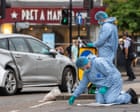
A standard police blotter entry out of London details the immediate facts. A car strikes pedestrians. Bystanders scatter. A man is arrested on suspicion of attempted murder. While standard breaking news coverage treats these incidents as isolated flashpoints of criminal intent, they are actually systemic failures of urban design and counter-terror architecture. When a vehicle becomes a weapon on a modern city street, it exposes a deep vulnerability in how municipal authorities protect public spaces.
The immediate aftermath of a vehicle-ramming incident follows a predictable script. Sirens, cordons, and a brief statement from Scotland Yard. Security analysts monitor the wires to see if the incident shifts from a localized criminal act to an organized national security threat. Yet, focusing strictly on the driver's motive misses the structural reality. The modern city remains fundamentally soft. Despite a decade of retrofitting major metropolises with barriers, bollards, and pedestrian zones, the interface between heavy vehicular traffic and human foot traffic remains poorly managed and inherently dangerous.
The Illusion of Perimeter Security
Following the high-profile vehicle attacks across Europe in the late 2010s, major cities promised to harden their cores. Millions of pounds were poured into Hostile Vehicle Mitigation (HVM) systems. Walk through Westminster, parts of the City of London, or near major transit hubs like London Bridge, and you will see the visible results. Heavy steel-reinforced bollards, disguised planters, and structural benches designed to stop a multi-ton truck traveling at high speeds.
They work, but only within a highly restricted footprint.
The vast majority of urban streets cannot be ringed with steel. Perimeter security suffers from a displacement effect. When a high-profile tourist zone is hardened, the vulnerability does not disappear; it merely migrates three blocks down the road to a street where pedestrians queue for buses or walk outside shops without the protection of a counter-ram barrier. Local councils face a constant, losing battle against geometry and budgets. Hardening every curb in a major city is financially impossible and architecturally ruinous.
Furthermore, many temporary barriers used for crowd control during events or in high-traffic weekend areas are fundamentally inadequate. Water-filled plastic barriers or standard metal fencing offer psychological comfort to the public but provide near-zero structural resistance against a vehicle moving at speed. Security planners know this, yet the deployment of cosmetic security remains widespread because it satisfies the immediate bureaucratic need to show action.
The Geometry of a Hard Target
To understand why these incidents keep happening, look at how street design actively facilitates vehicular violence. Standard urban traffic engineering prioritizes vehicle throughput and flow. Long, straight avenues allow drivers to build significant momentum. Wide turning radiuses designed to accommodate delivery trucks also mean a rogue vehicle can mount a sidewalk without losing speed.
True defensive urbanism requires a complete inversion of classic traffic planning.
- Chicanes and Deflections: Introducing artificial curves into straight roads forces drivers to slow down, breaking up potential acceleration zones.
- Continuous Sidewalks: Forcing vehicles to cross an elevated pedestrian path when turning, rather than having pedestrians step down into a traditional intersection, changes the power dynamic of the street.
- Integrated Street Furniture: Utilizing heavy structural elements like reinforced bus shelters and deeply anchored bike racks as passive defense networks rather than relying solely on dedicated security bollards.
Implementing these changes requires breaking down the silos between counter-terrorism experts, highway engineers, and local zoning boards. Currently, these groups operate on completely different tracks. A transit authority wants to clear traffic quickly; a security team wants to disrupt vehicular movement. Until defensive design becomes a baseline requirement for standard civil engineering rather than an afterthought handled by security consultants, the vulnerabilities will remain baked into the concrete.
The Limits of Automotive Automation
The tech sector frequently presents a silver bullet. Autonomous braking systems, pedestrian detection algorithms, and connected vehicle technology are advertised as the end of human error and malice on the road. European regulations have pushed for mandatory Intelligent Speed Assistance and Advanced Emergency Braking Systems in newer vehicle models.
The reality on the ground is far less clinical.
First, the average age of a vehicle on British roads hovers around ten years. Millions of cars currently in operation possess zero automated intervention capabilities. A driver intent on using a car as a weapon simply needs to select an older, purely mechanical model to bypass any electronic guardrails completely.
Second, even modern driver-assist systems are remarkably fragile. They rely heavily on cameras, radar, and lidar sensors that can be easily compromised. Heavy rain, thick fog, or dirt accumulation on a bumper can degrade sensor performance significantly. More critically, these systems are designed to prevent accidents, not to counter deliberate intent. A driver who overrides the system by maintaining heavy pressure on the accelerator can, in many models, force the vehicle to ignore its own braking warnings. The software is programmed to trust the human operator in emergency maneuvers, a loophole that malicious actors exploit.
The Intelligence Gap in Lone Actor Scenarios
When a suspect is detained on suspicion of attempted murder following a vehicle strike, the immediate task for investigators is mapping out a network. They look for ideological blueprints, online radicalization trails, or co-conspirators. This is the traditional domain of state security services, and it is a framework built for a different era.
The most difficult threat to intercept is the spontaneous actor using everyday tools.
When an individual decides to use a standard passenger vehicle to cause mass harm, the timeline from intent to execution can be a matter of minutes. There is no firearms acquisition trail. There is no bomb-making material to detect via chemical sniffer or online purchase monitoring. The weapon is already parked outside on the street, legally registered and completely unremarkable.
This reality breaks the standard intelligence lifecycle. Traditional surveillance and data mining rely on identifying anomalies. A routine commute that ends in a sudden swerve into a crowd contains no anomalous pre-incident indicators that an algorithm or an intelligence analyst can flag in real-time. The security apparatus is left chasing the aftermath, attempting to reconstruct a motive when the physical damage has already been done.
Reforming Municipal Liability
If the technical and intelligence solutions are limited, the leverage point shifts to administrative and civil accountability. Currently, when a vehicle ramming occurs, the legal focus centers almost exclusively on the criminal prosecution of the driver. The broader failure of the space itself is rarely scrutinized in a court of law.
This structural immunity for property owners and municipal authorities is beginning to fracture.
There is an emerging legal argument that if a public space experiences high foot traffic and lacks basic, industry-standard physical protection, the entity responsible for that space bears civil liability for negligence. If a restaurant chain can be sued for a slippery floor, a city or a major commercial landlord should face scrutiny for failing to secure a crowded plaza from predictable vehicular incursions.
Shifting the financial burden onto municipalities and insurers would instantly change the calculus. When a lack of defensive bollards becomes a major insurance liability, the bureaucratic inertia that slows down urban retrofitting will evaporate. Landlords and local councils will find the budget for structural security not out of a sense of civic duty, but to protect their bottom lines from catastrophic civil judgments.
The Real Cost of Soft Cities
We live in an era where public spaces are increasingly privatized yet structurally neglected. We demand vibrant, walkable outdoor dining districts and bustling high streets, but we refuse to build the physical infrastructure required to protect them from the realities of modern urban risks. A city that relies on police cordons and emergency response after the fact is a city that has failed its population.
True security is silent, structural, and built into the foundational layout of the environment. It does not require a heavily armed police presence on every corner or intrusive surveillance networks checking every driver's credentials. It requires concrete, steel, and a fundamental refusal to let vehicles dominate the physical geography of human life. The incident in London is not a freak occurrence to be filed away until the next news cycle breaks. It is a direct warning that the ground beneath our feet is poorly designed, and the cost of that design flaw is paid in human lives.