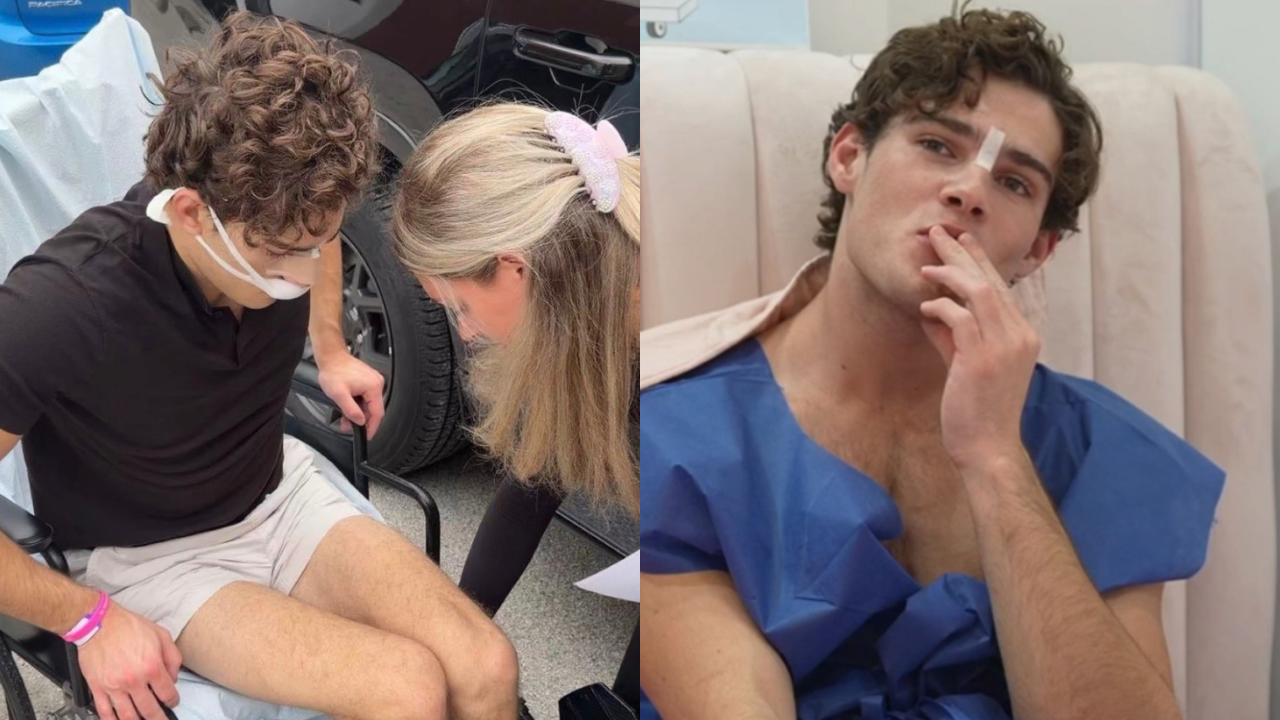
A single image circulating online this week captured the reality of the modern male aesthetic crisis. In it, the internet personality known as Clavicular sits in a wheelchair, a white nasal splint taped firmly across the bridge of his nose. That much was expected; he had recently undergone a rhinoplasty. What caught the internet by surprise was further down. Thick, heavy orthopedic frames enclosed both of his legs, stretching the fabric of his sweatpants.
The image immediately triggered a wave of speculation across social platforms, with users asking why a routine nose job required a wheelchair and dual leg braces. The answer points toward a much more grueling, expensive, and secretive procedure: cosmetic limb lengthening. While representatives for the creator have not issued a formal confirmation, the distinct hardware visible in the frame is instantly recognizable to anyone tracking the rapid rise of the "looksmaxxing" subculture.
This is no longer a fringe internet obsession. It is a booming, multi-million-dollar medical industry catering to young men who are choosing to have their healthy bones shattered in pursuit of an arbitrary structural ideal.
The Architecture of Distraction Osteogenesis
To understand the lengths to which these patients are going, one must look at the brutal biomechanics of the surgery itself. The procedure relies on distraction osteogenesis, a technique originally developed to correct severe congenital deformities or traumatic injuries.
[Healthy Bone] ──> [Surgical Fracture] ──> [Gradual Mechanical Tension] ──> [New Bone Growth]
The process requires an orthopedic surgeon to deliberately break the patient's femur or tibia. Once the bone is severed, an adjustable internal motorized nail or an external fixation frame is surgically anchored into the fragments.
The true trial begins during the recovery phase. Over the course of several months, the mechanical apparatus is adjusted daily—typically in increments of one millimeter. This precise, agonizing tension pulls the bone fragments slightly apart, forcing the human body to continuously deposit new bone tissue into the gap.
Gaining three inches of height means living with unhealed, structurally compromised leg bones for the better part of a year. The physical toll is immense. The muscles, nerves, and blood vessels are stretched to their absolute physiological limits, resulting in chronic, deep-tissue pain that requires heavy pain management and months of intensive physical therapy just to regain basic mobility.
The Cost of Extra Inches
The financial barrier to entry is as steep as the physical recovery. In premier clinics across the United States, Western Europe, and specialized hubs in Turkey, the financial breakdown reveals an industry operating at a massive premium.
| Expense Category | Estimated Cost Range (USD) |
|---|---|
| Bilateral Femur Lengthening | $75,000 - $120,000 |
| Anesthesia & Operating Room Fees | $10,000 - $15,000 |
| Post-Operative Physical Therapy | $5,000 - $12,000 |
| Hardware Removal Surgery | $15,000 - $25,000 |
| Total Investment | $105,000 - $172,000 |
Moving Beyond the Face
For years, the plastic surgery market was dominated by facial optimization. Creators built entire platforms around jawline contouring, rhinoplasties, and orbital rim implants. But the goalposts have shifted. The internet subcultures driving these trends have realized that a symmetrical face loses its social currency if it sits atop a frame that fails to meet shifting societal benchmarks for male dominance.
Height has become the ultimate metric of male value in these digital spaces. The fixation is fueled by a relentless stream of content equating height with financial success, romantic viability, and social authority. When prominent influencers document or hint at undergoing these extreme skeletal transformations, it normalizes an invasive medical intervention as a standard self-improvement milestone.
The phenomenon exposes a deep-seated vulnerability. These men are not seeking minor cosmetic enhancements; they are trying to re-engineer their fundamental biology to escape profound status anxiety.
The Orthopedic Compromise
The medical community remains sharply divided over the ethics of performing such invasive procedures for purely cosmetic reasons. While a successful surgery can undeniably alleviate severe body dysmorphia for some patients, the long-term trade-offs are rarely discussed with the same enthusiasm as the before-and-after photos.
Shattering a perfectly healthy bone carries systemic risks. Beyond the immediate dangers of deep vein thrombosis, fat embolisms, and bone infections, there is the lingering question of long-term joint health. Altering the natural leverage and alignment of the lower limbs changes how force distributes across the knees, hips, and ankles.
Decades down the line, these patients may face premature osteoarthritis, chronic muscle tightness, or a permanent reduction in athletic performance. The bargain is explicit: a handful of centimeters today in exchange for the structural integrity of the musculoskeletal system tomorrow.
The Normalization of Extreme Modification
The image of an influencer recovering from a nose job while simultaneously lengthening their legs is a stark preview of where the male grooming and wellness industry is heading. What began as an online subculture trading tips on facial asymmetry has evolved into an ecosystem where major orthopedic surgery is treated like a software update.
As these procedures become more accessible and socially accepted within certain digital echo chambers, the boundary of what constitutes reasonable cosmetic alteration continues to erode. The modern male beauty standard is no longer defined by fitness or style, but by structural renovation.
When the human skeleton is treated as a customizable asset, satisfaction remains permanently out of reach. The cast on the nose and the frames on the legs are not just medical tools; they are the physical manifestations of an endless, painful pursuit to fix a perceived flaw that was never structural to begin with.