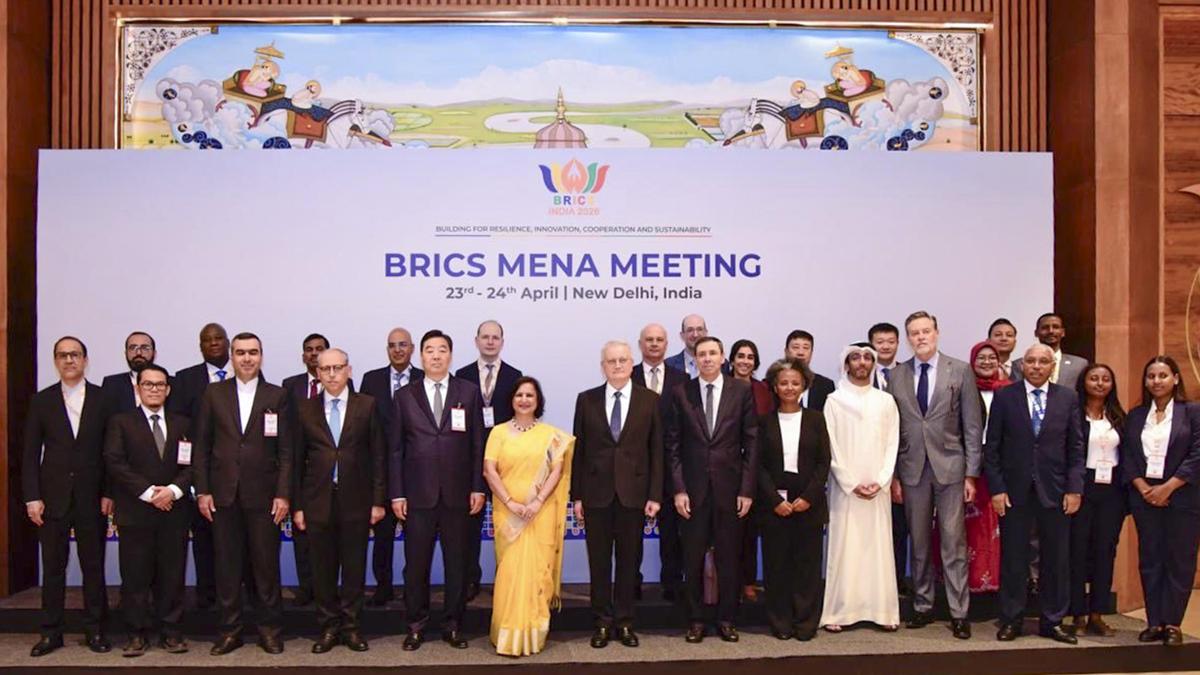
The dream of a unified Global South encountered a hard reality in the meeting rooms of the BRICS summit, where the ambition to present a monolithic front crumbled under the weight of ancient rivalries and modern geopolitical pragmatism. While the bloc intended to issue a soaring joint declaration on the Middle East, the effort hit a wall. New Delhi’s refusal to sign off on harsh, one-sided language regarding the Israel-Palestine conflict, coupled with a fundamental disconnect between the UAE and Iran, effectively silenced the group.
This was not a minor clerical error. It was a failure of the BRICS expansion experiment.
When the group invited major Middle Eastern powers into its fold, the theory was that economic interest would override regional friction. Instead, the recent failure to produce a unified statement proves that adding more seats to the table only adds more vetoes. India acted as the primary anchor, dragging the collective sentiment away from the fiery rhetoric favored by Tehran and Pretoria, insisting instead on a balanced approach that acknowledged the complexities of the October 7 attacks.
The Indian Veto and the Art of the Middle Path
India’s role in the collapse of the joint statement highlights a shift in its foreign policy that many analysts have missed. For decades, New Delhi was a reliable vote for the Palestinian cause. That era is over. Under the current administration, India has built a strategic architecture that treats Israel as a vital defense and technology partner while maintaining crucial energy ties with the Gulf.
The proposed draft of the BRICS statement was, from the Indian perspective, an unacceptable throwback to Cold War-style non-alignment. It focused heavily on Israeli aggression without what New Delhi considered sufficient mention of the terror attacks that sparked the current cycle of violence. By thinning out the language, India signaled that it will no longer allow BRICS to be used as a platform for anti-Western or anti-Israeli signaling that contradicts its bilateral interests.
This creates a structural problem for the bloc. If every major geopolitical event requires a unanimous consensus that must pass through the Indian filter, the group’s ability to act as a rapid-response diplomatic force is non-existent. India is essentially playing a double game: it wants the prestige of the BRICS membership to counter Chinese dominance, but it refuses to let the group dictate its stance on the most volatile issue in global politics.
The UAE and Iran A Marriage of Inconvenience
The friction between Abu Dhabi and Tehran provided the second fracture point. While both are now members of the expanded BRICS+, their visions for the region remain diametrically opposed. The UAE has invested heavily in the Abraham Accords and a post-conflict regional economy built on stability and trade. Iran, conversely, views the current chaos as an opportunity to assert its "Axis of Resistance."
During the negotiations for the joint statement, the UAE sought language that promoted regional de-escalation and protected maritime trade routes—a thinly veiled reference to the Houthi disruptions in the Red Sea. Iran, predictably, balked at any phrasing that could be interpreted as a critique of its proxies.
This internal standoff reveals the fundamental flaw in the "Big Tent" strategy. You cannot bring the arsonist and the architect into the same room and expect them to agree on a blueprint for the neighborhood. The UAE's presence in BRICS is a hedge; they want to be part of the new economic order, but they have no intention of joining a diplomatic front that is governed by Iranian interests.
The Cost of Neutrality
Russia and China, the senior partners of the group, watched this stalemate with a mix of frustration and resignation. For Moscow, a strong, unified BRICS statement would have been a propaganda win, showing that the "Global Majority" stands against the US-led order. Instead, the silence from the summit spoke louder than any paragraph they could have drafted.
The failure to reach a consensus is a win for Washington. It proves that despite the talk of a "post-American world," the nations within BRICS are too divided by their own border disputes, religious rivalries, and economic dependencies to offer a coherent alternative to Western diplomacy.
We are seeing the limits of "minilateralism." When a group grows too large without a shared security framework, it reverts to the lowest common denominator. In this case, the lowest common denominator was total silence.
Why the Consensus Model is Breaking
BRICS operates on a consensus-based decision-making process. In the original five-member configuration, this was difficult but manageable. With the expansion, it has become a liability. The group now includes:
- India, which views the US as a strategic partner.
- Iran, which views the US as the "Great Satan."
- The UAE, which hosts US military bases while trading with China.
- Brazil, which wants to lead the Global South but avoid a trade war with the West.
When these disparate actors sit down to discuss Gaza, there is no middle ground. There is only a void. The Indian delegation's insistence on "diluting" the language was not just about Israel; it was about protecting the integrity of India's sovereign foreign policy from being hijacked by a committee.
The Economic Mirage
The hype surrounding BRICS has always been about the "R" and the "I"—the growth engines. The political expansion was supposed to give that economic weight a voice. But as this recent summit proved, a voice is useless if it has a stutter.
Investors and geopolitical strategists should take note: BRICS is not becoming a "Southern NATO" or even a coherent political union. It is becoming a high-level talking shop where the most important work happens in the hallways, not in the joint communiqués. The inability to agree on a Middle East statement suggests that on any issue involving hard security or sensitive alliances, the bloc will remain paralyzed.
The reality of the current global order is that national interest remains the supreme driver. India will not sacrifice its relationship with Israel for the sake of BRICS solidarity. The UAE will not align its rhetoric with Iran to please a collective.
If the bloc cannot find a way to reconcile these internal contradictions, it risks becoming another UN General Assembly—a place where speeches are made, but nothing is decided. The dilution of the statement was a tactical victory for Indian diplomacy, but a strategic warning for the future of the BRICS project.
The next few years will determine if the group can move beyond being a collection of acronyms and become a functional entity. If the Middle East was the litmus test, the results are currently coming back inconclusive at best and disastrous at worst. The fault lines are not just in the sand; they are baked into the very foundation of the expanded alliance.
The world expected a roar from the new BRICS. What it got was a whisper.