The black water of the Strait of Hormuz does not look like a fuse. But if you stand on the coast of Oman or Iran and watch the massive tankers groan under the weight of twenty million barrels of crude every single day, you can feel the heat.
It is a narrow ribbon of sea. At its tightest bottleneck, the shipping lanes are just two miles wide. Through this marine throat squeezes one-fifth of the world’s petroleum consumption. It is a terrifyingly fragile reality. A single miscalculated naval maneuver, a stray drone, or a sudden geopolitical tantrum could close the strait. If that happens, the global economy does not just slow down. It breaks.
For decades, the United Arab Emirates has stared at this vulnerability from the inside of the Persian Gulf. They are locked in the room. To get their primary source of wealth to the factories of Asia and the ports of Europe, they must pass through a corridor controlled by volatile neighbors.
Imagine a hypothetical pipeline engineer named Tariq. He does not spend his days analyzing stock tickers or reading diplomatic cables. He looks at maps of topology, the friction coefficients of steel, and the brute force required to push liquid over mountains. For men like Tariq, the Strait of Hormuz is not a political talking point. It is a chokehold. Every barrel loaded onto a ship west of the strait is a hostage to fortune.
The UAE has decided it will no longer live at the mercy of geography.
The Weight of a Single Mile
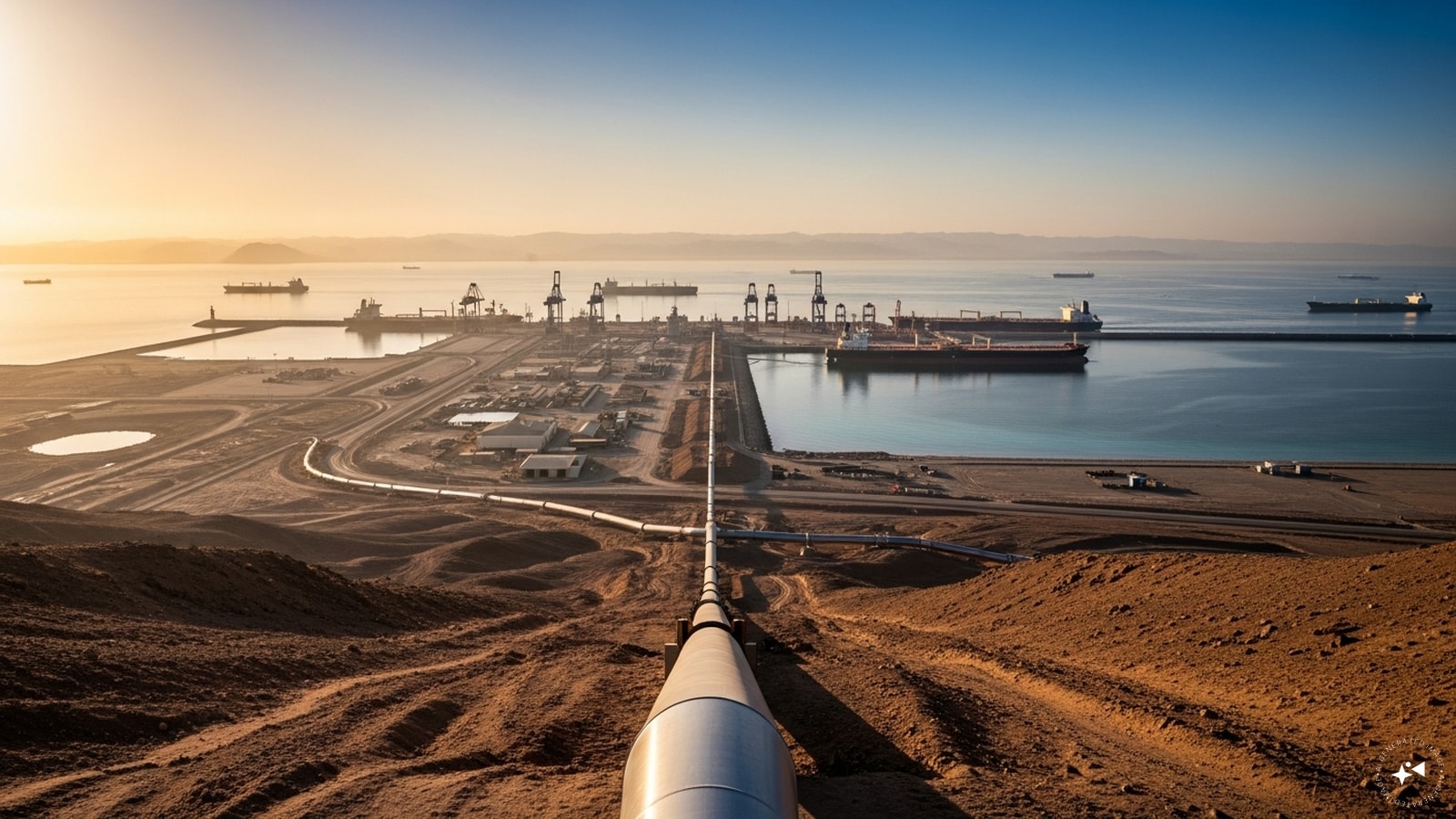
To understand the sheer scale of what is unfolding, you have to look past the press releases and focus on the dirt. The UAE is quietly orchestrating a massive infrastructure shift to alter the flow of global energy. The goal is brutal in its simplicity: move the oil across the desert, over the rugged Hajar Mountains, and dump it straight into the Gulf of Oman at Fujairah.
Fujairah sits safely outside the strait. It faces the open ocean. From its docks, ships can sail directly to India, China, or Japan without ever entering the claustrophobic confines of the Persian Gulf.
The existing Habshan–Fujairah pipeline was the first major stroke in this strategy. It spans roughly 230 miles of unforgiving terrain. Think of it as a massive, steel artery pulsing through the desert heat, capable of moving 1.5 million barrels a day. But 1.5 million barrels is just a fraction of the UAE's total output. It was a proof of concept, a safety valve. It was not a total solution.
Now, the math is changing. The UAE plans to double its export capacity through new, parallel infrastructure corridors by 2027. We are talking about pushing their total export capability past 5 million barrels per day, with a massive portion of that rerouted to entirely circumvent the volatile waterway.
Consider the physics of this operation. You cannot simply build a bigger pipe and turn on a spigot. The oil must be gathered from fields deep in the western deserts, like Upper Zakum and Bab. It must be pressurized by massive pumping stations that consume enough electricity to power small cities. It must climb over jagged peaks where the elevation changes subject the steel to immense stress.
When you stand near the terminal in Fujairah, the scale hits you in the chest. The storage tanks look like silver cities springing from the rocky earth. They hold millions of barrels, waiting for the supertankers that tether to offshore loading buoys. It is a industrial symphony conducted at the cost of tens of billions of dollars.
The Anatomy of an Obsession
Why spend this kind of capital when the Strait of Hormuz is currently open and functioning? Because risk is a silent tax.
Every time a rebel group launches a drone in the Red Sea, or an oil tanker is detained in the Gulf, insurance premiums for shipping companies spike. These are not minor adjustments. They are massive financial penalties that ripple through the supply chain, eventually showing up at gas pumps in Chicago and plastics factories in Seoul.
By building a guaranteed escape hatch, the UAE is buying something far more valuable than oil revenue: they are buying certainty.
Let us look at the geopolitical chessboard. Iran sits on the northern northern shore of the strait. On multiple occasions, Tehran has threatened to shut down the passage if its own survival is threatened. Even if those threats are eighty percent bluster, the remaining twenty percent is enough to keep energy ministers awake at night.
But the real problem lies elsewhere. It is not just about war; it is about the changing center of gravity for global energy. The buyers are no longer primarily in the West. The frantic demand is coming from the East.
When a tanker leaves Abu Dhabi, passes through the strait, and heads toward India, it wastes precious days navigating treacherous, crowded waters. By moving the loading zone to Fujairah, the UAE shaves crucial time off the voyage to the Asian markets. It turns a strategic defensive move into an offensive commercial advantage.
The Engineering of Sovereignty
The work happening out in the desert is grueling. The temperature in the summer regularly breaches 120 degrees Fahrenheit. The sand acts like liquid sandpaper on heavy machinery.
Engineers face a unique set of problems when dealing with heavy crude. If the oil moves too slowly, it cools down and becomes viscous, threatening to clog the line like a blocked artery. If it moves too fast, the friction can cause dangerous pressure buildups. The new pipeline initiatives require advanced thermal monitoring and automated pressure-release systems that can detect a microscopic tear in the steel from hundreds of miles away.
This is where the narrative of "just another oil state" falls apart. This is a high-tech survival strategy dressed up in industrial steel.
Some critics argue that spending billions on fossil fuel infrastructure by 2027 is a fool's errand in an era obsessed with energy transitions. They ask why a nation would double down on oil pipelines when the world is talking about solar panels and electric vehicles.
The answer is found in the cold reality of global consumption metrics. Even in the most aggressive decarbonization scenarios, the world will still require millions of barrels of oil per day for petrochemicals, aviation, and heavy industry for decades to come. The UAE’s calculation is simple: when the global demand for oil eventually shrinks, the last producers standing will be the ones who can deliver it the cheapest, the safest, and with the least amount of geopolitical drama.
By bypassing Hormuz, they ensure their oil is the most reliable on Earth.
The Coastline of Tomorrow
If you walk along the beaches of Fujairah today, you can see the old world rubbing shoulders with the new. Traditional fishing boats still bob in the surf, their crews hauling in nets just miles away from where the massive VLCCs (Very Large Crude Carriers) drop anchor.
The fishermen look out at the steel hulls dominating the horizon. They know that the water beneath those ships is no longer just a local fishing ground; it is the vital valve of an entire nation’s future.
The new pipelines will alter this coast forever. More berths will be carved into the rock. More storage farms will paint the hillsides silver. The quiet emirate, once known mostly for its rugged mountains and clean water, is being forged into the central station of global energy transit.
Tariq, or any of the hundreds of real engineers supervising the welding teams out in the dunes, knows that every joint must be perfect. A single bad weld can halt the flow. A single failure can bring the eyes of the world crashing down on this strip of coast. They work with a quiet intensity, under a sun that bleaches the sky white, burying the massive pipes deep beneath the gravel plains.
The project is moving forward, kilometer by kilometer, toward the 2027 deadline. When the final valves are turned and the oil begins to surge through the new loops, bypassing the most dangerous chokepoint on the map, the geography of the Middle East will not have changed. But its power dynamic will be unrecognizable.
The desert wind blows across the Hajar peaks, carrying the faint sound of heavy machinery moving earth, shifting the destiny of a nation that refused to be trapped by its own coast.