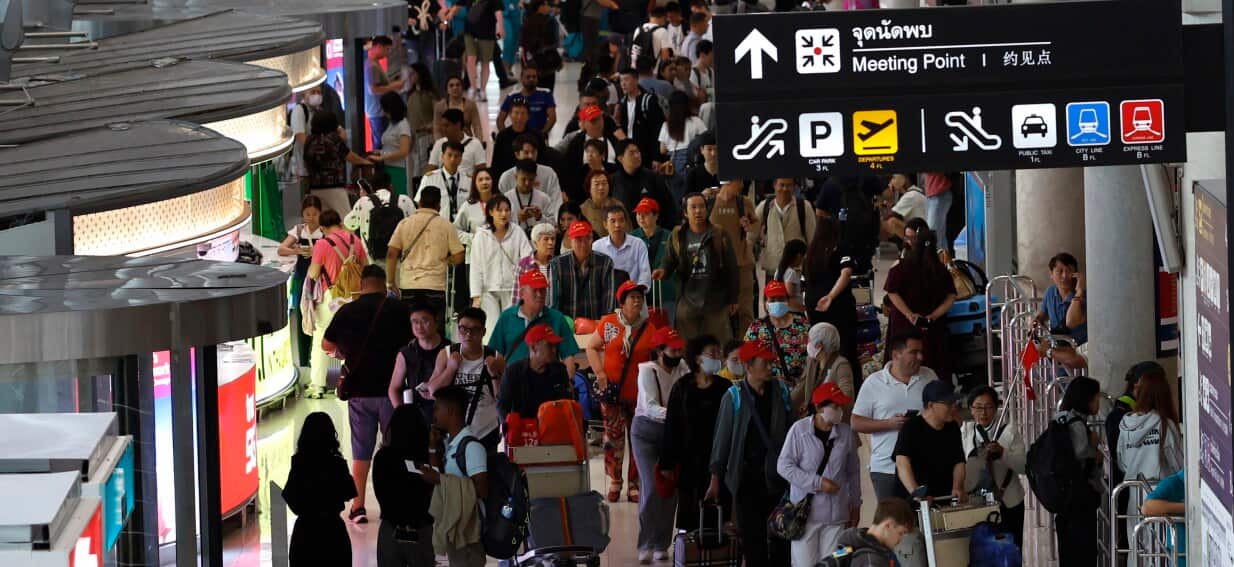
The gray plastic bin slides across the stainless steel table with a sharp, metallic screech. It is 5:15 AM. The air in the terminal tastes faintly of jet fuel and expensive, burnt coffee. Under the buzzing fluorescent lights, a traveler steps onto the painted yellow footprints, raises their arms in a submissive posture, and waits for the invisible waves of the body scanner to pass through them.
For a quarter of a century, the face watching the monitor on the other side of that glass has belonged to a federal employee. The patch on the shoulder read Transportation Security Administration. It was a uniform born out of the ash and panic of September 11, a visible statement that national security was a sacred public trust.
But a quiet migration is underway at the checkpoint.
If you fly through San Francisco, Orlando, or a growing handful of other American hubs, the person telling you to take your shoes off does not work for the federal government. They work for a private corporation. They wear a different patch. And if the TSA gets its way, this corporate footprint is about to expand significantly across the nation’s aviation network.
The agency calls it the Screening Partnership Program. Critics call it privatization through the back door. To the average traveler, rushing to catch a flight, the difference might seem entirely semantic. A badge is a badge. A pat-down is a pat-down.
It matters.
The shift from public civil service to private enforcement alters the very DNA of public safety, accountability, and the labor market hidden right beneath our noses.
The Cost of the Badge
To understand why the government wants to hand over the keys to the checkpoint, you have to look at the people standing on the rubber mats for eight hours a day.
Consider a hypothetical officer named Marcus. He has been with the TSA for seven years. He knows the exact density of a bottle of breast milk on the X-ray screen versus a liquid explosive. He can spot a hidden pocket knife in a backpack within three seconds. But Marcus is tired. His lower back aches from leaning over baggage. More importantly, his salary has historically lagged behind almost every other federal law enforcement agency.
For years, the TSA suffered from an existential crisis of retention. In some years, attrition rates crept toward 20 percent. The agency was a revolving door, constantly spending millions of tax dollars to recruit and train officers who quit six months later because they could make more money managing a local retail store without the stress of being yelled at by business class passengers.
Congress stepped in recently with a massive pay equity infusion to bridge that gap, but the financial strain on the federal budget remains immense.
Enter the private sector.
Under the Screening Partnership Program, an airport can apply to opt out of federal TSA screeners. If approved, the TSA contracts with a private security firm—companies like Covenant Aviation Security or Trinity Technology Group—to handle the physical screening. The federal government still sets the security standards, provides the equipment, and oversees the operation. But the human beings pushing the bins are private employees.
The pitch from proponents is simple: efficiency. Private companies can adapt faster. They can scale up their staffing for Thanksgiving weekend without navigating the labyrinth of federal hiring regulations. If an employee isn't working out, they can be let go without a multi-month bureaucratic review.
But efficiency is a double-edged sword.
The Invisible Corporate Friction
When a private entity enters a space previously reserved for the state, the underlying motivation shifts. A government agency answers to Congress and the public, theoretically measured by safety outcomes. A corporation answers to a balance sheet.
Imagine the pressure points. A private security firm wins a contract by promising to meet TSA standards at a competitive price. To maintain profitability, where do they find efficiencies? It rarely comes from the equipment, which the government provides. It comes from labor.
While the law dictates that private screeners must receive compensation and benefits equal to or greater than their federal counterparts, the long-term calculus of corporate management introduces subtle variables. Pension structures change. Healthcare plans shift. The collective bargaining power that federal workers fought decades to secure can become fragmented.
There is a psychological shift, too. When you wear the seal of the United States on your sleeve, there is an implicit understanding of duty. It is a weight. If a private officer misses a weapon, the company risks losing a multi-million dollar contract. The incentive to avoid failure becomes commercial as much as it is patriotic.
This introduces an uncomfortable tension at the heart of security. Do we want the person checking our bags to be thinking about a corporate performance metric, or national defense?
The data on whether private screeners perform better than federal ones is notoriously murky. Over the years, various government accountability studies have pitted federal airports against private ones. The results usually end in a statistical wash. Sometimes the private contractors catch a few more prohibited items; sometimes the federal workers show greater consistency.
The real divergence isn't in what they find in the bags. It is in how the system handles the human beings involved.
The Fragmented Sky
If you look at the map of airports that have already embraced privatization, a pattern emerges. It isn't the massive, sprawling mega-hubs leading the charge, with a few notable exceptions like San Francisco. Instead, it is often smaller, regional airports or specialized hubs where local authorities feel they are ignored by a distant bureaucracy in Washington.
A local airport director in a mid-sized Midwestern city faces a distinct problem. During the summer, tourism spikes. During the winter, the terminal is a ghost town. When they rely on the federal TSA, asking for an extra dozen screeners for July can take a year of paperwork. The local economy suffers while lines stretch out into the parking garage.
To that director, privatization looks like salvation. They can call the regional manager of a security firm and demand more staff next week. The local authority regains a sense of control over their own front door.
But this creates a fragmented security landscape. Instead of a single, unified wall protecting American airspace, we are moving toward a patchwork quilt of corporate entities. One airport is secured by Firm A, the next by Firm B, and the third by the traditional federal workforce.
Information sharing, standardized training updates, and cultural cohesion become harder to maintain when different corporate entities are managing the ground-level staff. An update to an X-ray protocol that rolls out instantly across the federal workforce must be filtered through corporate hierarchies and contract amendments in the private sector.
The Ghost in the Line
The next time you travel, watch the line move.
The mechanics of aviation security are designed to make us forget the individuals performing it. We focus on the machines, the signs, the timers, and our own ticking clocks. We see the uniform, not the person inside it.
But the expansion of private security at our checkpoints forces a deeper question about what we owe to the people who protect our public spaces, and what we lose when we commodify that protection.
The push to expand these private contracts isn't happening in a vacuum. It is part of a broader, decades-long trend of outsourcing the core functions of the state—from prisons to military logistics—to private enterprises. It promises flexibility and cost savings, but it often delivers a dilution of public accountability.
The woman checking your ID at the gate might soon be an employee of a company traded on Wall Street. She will still look at your license. She will still look at your face. But the contract binding her to your safety will have a profit margin calculated into the margin of error.
We are trading a flawed, heavy federal system for a nimble, corporate experiment. As the lines grow longer and the summer travel season looms, the true cost of that trade won't be measured in dollars saved on a government spreadsheet. It will be measured at the checkpoint, one plastic bin at a time, in the quiet spaces where public trust meets private enterprise.