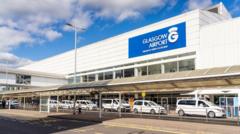
A major summer travel crisis in Scotland evaporated over the weekend as nearly 400 frontline workers at Glasgow Airport accepted eleventh-hour pay deals. The agreement removes the immediate threat of gridlock during peak holiday weeks, the FIFA World Cup, and the Commonwealth Games. Security screeners and ground handling crews voted overwhelmingly to accept revised terms, backing down from coordinated walkouts. While passengers can breathe easier, the resolution masks a much deeper, structural friction within the aviation supply chain. This is not a simple story of labor winning a fair wage; it is a symptom of an aggressive outsourcing model that is pushing regional airports to a breaking point.
To understand why Glasgow Airport came within days of a shutdown, one must look past the airport authority itself and examine the labyrinth of private contractors running critical infrastructure.
The Economics of a Grounded Standoff
The averted industrial action involved two primary groups of workers. Around 230 security staff employed by ICTS, the private firm contracted to handle passenger screening, accepted a two-year deal. They will receive a 5% increase backdated to January, a one-off bank holiday payment, and an inflation-linked rise matching the Retail Price Index plus 1% in 2027. Concurrently, 160 ground services crew employed by Menzies Aviation—including dispatchers, airside agents, and baggage controllers—backed a one-year deal delivering a 4.4% backdated increase, rising up to 11.1% for the lowest-paid tiers by July.
On paper, these are substantial, inflation-beating victories for Unite the Union. Beneath the celebratory press releases, however, lies the uncomfortable financial reality of modern aviation infrastructure.
Aviation operates on razor-thin margins, but those margins are distributed unevenly. While airlines aggressively squeeze airports on landing fees, airports increasingly outsource core functions to international service conglomerates to keep operational expenditures low. ICTS and Menzies Aviation are not small local businesses. Menzies recently posted global annual revenues of $3 billion, while the UK arm of ICTS saw its annual profits jump from £4.4 million to £7.6 million.
Workers noticed this profit migration. When frontline staff see corporate balance sheets expanding while their own household budgets are eroded by systemic inflation, industrial friction becomes inevitable. The strike weapon was used here with surgical precision, leveraging the threat of maximum reputational damage during a high-profile summer sporting calendar to extract concessions that the companies claimed for months they could not afford.
The Fractured Airport Ecosystem
The public often views an airport as a single corporate entity. If a flight is delayed or security lines stretch out the door, Glasgow Airport gets the blame. In reality, a modern airport functions more like a landlord managing an uneasy federation of private tenants.
This fragmentation creates a structural vulnerability. When an airport outsources its security to ICTS or its baggage handling to Menzies, it abdicates direct control over labor relations. If a contractor underpays its staff to win a competitive airport tender, the resulting labor shortage or strike threat still cripples the airport's operations. Glasgow Airport found itself held hostage by proxy. The airport management could not directly dictate the payroll terms of ICTS or Menzies, yet they faced the prospect of empty terminals and ruined vacations for thousands of Scottish travelers.
This structure also alters passenger rights in a way that many travelers do not realize. Had these strikes gone ahead, causing mass cancellations, airlines would likely have avoided paying passenger compensation under UK rules. Because the striking workers were employed by third-party airport contractors rather than the airlines themselves, the disruption is legally categorized as an extraordinary circumstance. Passengers would be left stranded, entitled only to basic care and rerouting, while airlines and contractors pointed fingers at one another.
Why the Post-Pandemic Labor Market Stiffened
The aviation industry is still haunted by the decisions it made during the global pandemic. When travel ground to a halt, thousands of veteran ground handlers, security officers, and engineers were made redundant or left the sector voluntarily. They did not wait for the industry to recover. Many retrained, finding more stable, less stressful shifts in logistics, warehousing, or local delivery networks.
When travel surged back, the aviation sector discovered that its reputational capital among workers had vanished. Recruitment became an expensive, protracted ordeal. To get a security badge for an airside worker, an applicant must undergo exhaustive background checks, employment history verification, and government counter-terrorism vetting. This onboarding process takes months.
Because replacement labor is exceptionally difficult to secure quickly, the existing workforce holds unprecedented leverage. The 98% strike mandates recorded in recent ballots across Scottish airports reflect a workforce fully aware of its own scarcity value. They know that if they walk out, a contractor cannot simply hire agency staff to fill the void next Wednesday.
The strategy adopted by trade unions has shifted accordingly. Rather than striking for a nominal cost-of-living adjustment, they are demanding structurally binding clauses, such as the RPI plus 1% formula secured by the ICTS staff for 2027. This insulates workers against future macroeconomic instability, shifting the financial risk squarely onto the corporate balance sheets of the contractors.
The Broader Scottish Aviation Crisis Is Not Over
While Glasgow has secured a temporary truce, the underlying labor dispute is part of a wider, systemic friction across the country. A separate dispute involving hundreds of workers at Edinburgh Airport Limited—including engineers, airfield support officers, and airport ambassadors—remains a live flashpoint.
The financial dynamics in the capital are even more stark. Edinburgh Airport Limited generated £144.4 million in profit in its latest recorded annual accounts, a steep climb from £88.2 million the prior year. When an airport authority directly employs staff and demonstrates that level of profitability, unions are disinclined to accept modest wage adjustments. The regional disparity creates a competitive labor environment. If ground handlers at Edinburgh secure a superior deal, it places immediate upward pressure on the wage demands of workers thirty miles west in Glasgow.
Airlines are watching this trend with growing alarm. Increased labor costs for contractors mean higher fees for airlines when their service contracts come up for renewal. Ryanair, EasyJet, and Loganair operate on tight schedules where a ten-minute delay in baggage turnaround destroys profitability for the entire day. If contractors scale back headcount to pay for higher hourly wages, service delivery degrades. If they pass the costs onto the airlines, ticket prices inevitably climb.
The Limits of the Strike Truce
The current peace at Glasgow Airport is pragmatic, but it is fragile. One-year deals, like the one signed by Menzies Aviation, mean that the entire negotiation circus will reset in twelve months. By the summer of 2027, inflation realities and corporate profit margins will change again, and the cycle will repeat.
For the private contractors, the strategy is clear: buy peace during the lucrative summer peak and attempt to claw back margins through automation or operational tightening during the quiet winter months. Travelers will see more self-service baggage drops, automated security lanes, and fewer human faces on the concourse.
The fundamental tension of the outsourced airport model remains unresolved. As long as regional airports rely on third-party service providers competing on cost, the frontline workforce will remain exposed to wage suppression. And as long as that workforce remains heavily unionized and legally irreplaceable at short notice, the threat of summer travel chaos will remain a permanent fixture of the British holiday season. The truce in Glasgow keeps the planes flying for now, but the economic fault lines beneath the tarmac are widening.