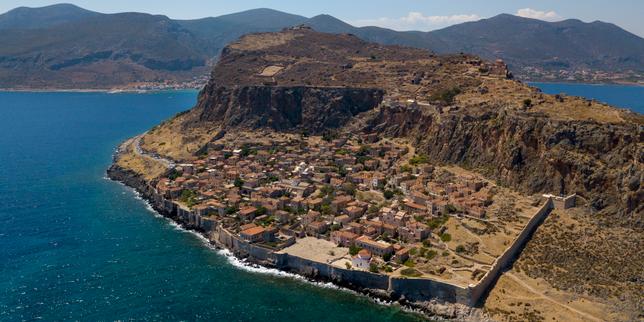
The medieval fortress city of Monemvasia, carved into a monolithic rock off the Peloponnese coast, is facing a transformation that threatens its very identity. Local authorities are pushing ahead with a controversial cable car project designed to ferry visitors from the lower town to the long-abandoned upper citadel. While officials pitch the infrastructure as an accessibility victory and an economic engine, residents and preservationists see an existential threat. The project exposes a deeper crisis in global travel: the relentless drive to commodify finite cultural heritage under the guise of modernization. Monemvasia does not need more foot traffic; it needs a strategy to survive the crowds it already has.
The Push for Accessibility or Mass Penetration
The Greek Ministry of Culture and local municipal leaders present the cable car as a progressive upgrade. Currently, reaching the upper town requires a grueling uphill trek along steep, uneven cobblestone paths. For elderly travelers or those with mobility impairments, the historic site is effectively off-limits. By installing a mechanized transit system, proponents argue they are democratizing access to one of Greece’s most significant Byzantine archaeological sites.
That narrative deliberately obscures the commercial mechanics at play. The project is funded through a mix of public money and regional development funds, justified by projected increases in ticket sales and overall visitor spending. But accessibility and mass tourism are not synonymous. True accessibility focuses on dignity and preservation; this initiative behaves like a high-throughput funnel designed to maximize daily turnover.
The Hidden Logistics of the Cable Car
Engineering a modern transit system into a fragile, centuries-old rock formation introduces severe structural risks. The upper town has remained relatively preserved precisely because its geography deters the casual, fast-moving tourist.
- Structural Vibrations: Heavy machinery anchors drilled into the limestone cliffs risk destabilizing the ancient perimeter walls.
- Visual Pollution: Steel cables and mechanical terminals inherently disrupt the preserved medieval skyline that makes Monemvasia unique.
- Crowd Spikes: A cable car system delivers tourists in dense, recurring waves rather than a steady, manageable trickle.
When hundreds of visitors arrive simultaneously at the upper citadel, the lack of infrastructure becomes a safety hazard. There are no expansive plazas or modern facilities at the top. The area is an open-air museum of crumbling ruins, narrow precipices, and delicate flora.
The Overtourism Trap
Monemvasia already operates at its limit during the peak summer months. The lower town, a labyrinth of narrow stone alleys filled with boutique hotels and tavernas, frequently suffers from pedestrian gridlock. Water scarcity is a recurring anxiety on the rock, and waste management systems are strained to the breaking point.
Adding an efficient pipeline to the upper town will not distribute the crowd evenly; it will compound the pressure on the entire ecosystem.
[Lower Town Bottleneck] ──> (Cable Car Funnel) ──> [Upper Citadel Overload]
       │                                                   │
       └──> Increased Waste, Water Strain, Loss of Character <──┘
The economic argument for the project relies on a flawed premise that has crippled other Mediterranean destinations like Venice and Dubrovnik. Local business owners are told that higher visitor volume equals higher revenue. In reality, mass day-trippers who use a cable car rarely spend significant money within the local economy. They arrive on tour buses, ride the attraction, take photos, and leave before dinner. The profits are concentrated in the hands of the transport operators and large-scale tour agencies, while the community absorbs the environmental and structural costs.
Preservation Under Siege
The core of the resistance from Monemvasia’s residents lies in a concept that economists struggle to quantify: the spirit of place. For decades, the rock has attracted a specific type of traveler willing to slow down, walk, and respect the silence of a fortified town. It is a living community, not an amusement park.
The Erasure of Authenticity
When a historic site is retrofitted for maximum convenience, it loses the friction that makes the experience meaningful. The climb to the upper town is undeniably difficult, but that difficulty serves as a natural regulatory mechanism. It demands time and effort, which naturally filters for visitors who are genuinely invested in the historical context.
Replacing that journey with a five-minute mechanical ride reduces history to a backdrop for a selfie. The upper ruins stop being a place of contemplation and become a theme park zone. This shift drives away the long-term, high-value cultural tourists who sustain local guesthouses during the off-season, replacing them with transient crowds that contribute little to the town's long-term viability.
A Better Path Forward
The debate should not be a binary choice between complete stagnation and reckless development. Access can be improved without building intrusive heavy infrastructure.
Instead of a permanent cable car, the municipality could invest in specialized, low-impact accessibility measures. A dedicated team of trained local guides equipped with specialized off-road mobility chairs could assist visitors who genuinely need help reaching the upper town. This approach creates local jobs, maintains the historical integrity of the site, and keeps visitor numbers at a sustainable level.
Furthermore, the funds allocated for the cable car would be far better spent restoring the crumbling structures within the upper town itself. Dozens of Byzantine-era buildings are structural hazards, closed off to the public due to a lack of conservation funding. Inviting thousands of new tourists to peer through chain-link fences at neglected ruins is a failure of imagination and stewardship.
The Final Reckoning for Greece’s Heritage
What is happening in Monemvasia is a warning shot for historic sites across Greece and the wider Mediterranean. When tourism policy is dictated solely by volume metrics and short-term construction contracts, the very assets that draw people to a country are systematically degraded.
Once the cables are strung and the concrete foundations are poured into the rock of Monemvasia, there is no turning back. The town will have traded its soul for a temporary spike in ticket sales, proving once again that the greatest threat to history is not time, but greed disguised as progress.