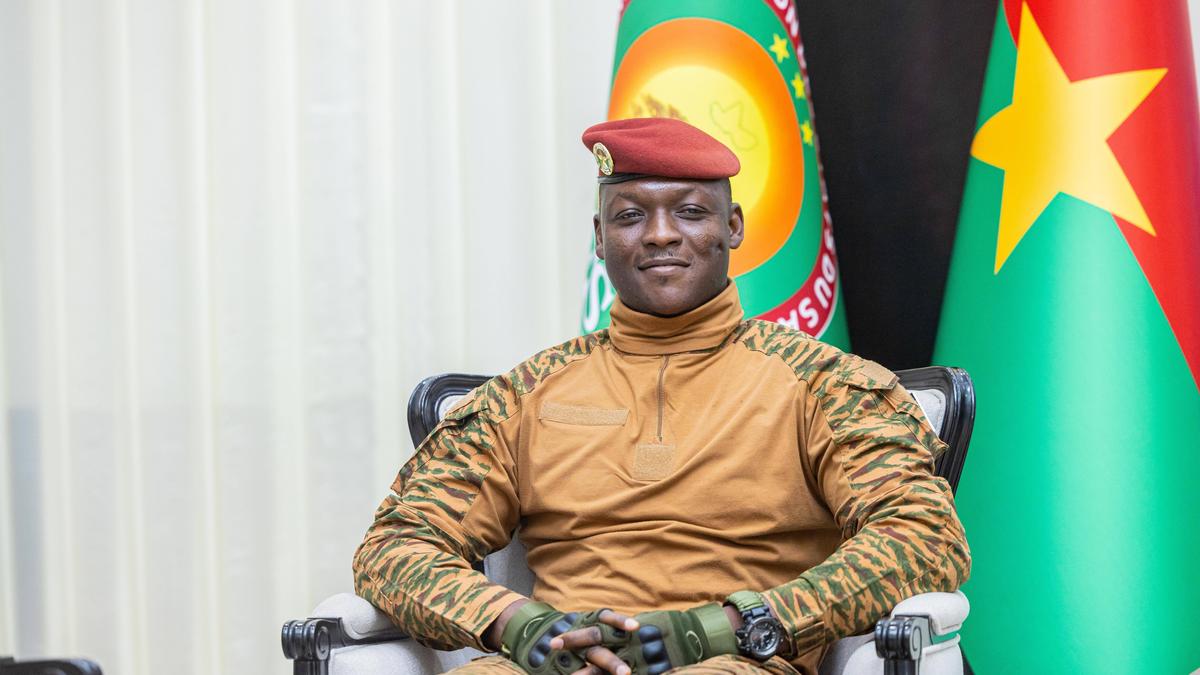
The dust in Ouagadougou doesn’t just settle; it stains. It clings to the throat, a fine, ochre silt that tastes of iron and history. In the central market, a merchant named Moussa—let’s call him that, though his name changes with the wind of whoever holds the microphone—watches the television screens flickered to life. He sees a man in a red beret, Ibrahim Traoré, leaning into a podium. Traoré isn’t talking about voting booths. He is talking about survival.
Moussa remembers the 2015 elections. He remembers the ink on his thumb and the hope that a paper slip could stop a kalashnikov. But the ink faded, and the guns stayed. For the people of Burkina Faso, the abstract concept of democracy has become a luxury they can no longer afford to store in their cupboards. When the Captain speaks of "forgetting democracy," he isn't just dismissing a Western ideal. He is betting that a hungry, frightened mother cares more about a safe road to the well than a ballot box she hasn’t seen in years.
Burkina Faso is hemorrhaging. Nearly half of the country sits outside government control, swallowed by a shifting tide of insurgent violence that treats borders like suggestions. When Traoré seized power in a 2022 coup—the second in a single year—he didn't just take the palace. He took the narrative. He positioned himself as the surgeon tasked with cutting out a cancer, and he has made it clear that he will not be interrupted by the "distraction" of an election cycle.
The Weight of a Red Beret
Security is a heavy word. It sounds like steel, but in the Sahel, it feels like absence. It is the absence of the motorbike roar that signifies a raid. It is the absence of the grief that follows a village massacre. Traoré’s argument is brutally simple: you cannot vote in a graveyard.
He recently signaled that elections, originally promised for July 2024, are no longer the priority. To the international community, this is a betrayal of the transition roadmap. To the young men in the streets of the capital, it sounds like a man who understands that a state under siege cannot afford the theater of a campaign. They see a leader who has ditched the suit for the fatigues, a man who invites Russian mercenaries from the Wagner Group (now rebranded as the Africa Corps) to fill the void left by departing French troops.
The shift is visceral. France, the former colonial master, is out. Russia is in. This isn't just geopolitics; it’s a desperate pivot born of a feeling that the "old ways" failed. When the French soldiers left, they took with them a certain kind of stability, however flawed. In its place is a raw, untethered nationalism. Traoré’s supporters don't see a dictator; they see a shield.
The Myth of the Quick Fix
But shields have a way of becoming cages.
Consider the "Volunteers for the Defense of the Homeland." These are civilians, often with more courage than training, handed rifles and told to protect their neighbors. It is a grassroots solution to a professional nightmare. But when you arm the populace without the oversight of a functioning judiciary or a democratic check, the lines between hero and vigilante blur into nothingness.
The facts on the ground are sobering. Since the military took over, the violence hasn't vanished. In fact, by some metrics, it has intensified. The insurgents—affiliates of Al-Qaeda and the Islamic State—are not impressed by a change in leadership. They don't care about the color of the beret. They thrive in the chaos.
Traoré’s rhetoric creates a binary world: you are either for the nation or you are a traitor. There is no middle ground for the journalist who asks about human rights abuses. There is no room for the activist who wonders if a five-year "transition" is just a permanent reign by another name. The air in Ouagadougou has grown thin for anyone who wants to speak a truth that doesn't align with the state’s daily bulletin.
The Ghost of Thomas Sankara
To understand why a 36-year-old Captain can command such loyalty while dismantling democratic pillars, you have to understand the ghost that haunts the palace. Thomas Sankara, the "Che Guevara of Africa," was a young military officer who transformed the country in the 1980s before his assassination. He preached self-reliance, burned the vestiges of colonialism, and spoke to the dignity of the poor.
Traoré invokes Sankara’s memory with every breath. He wears the same style of beret. He uses the same sharp, revolutionary cadence. For many Burkinabè, democracy was a foreign export—a clunky, expensive machine that required constant maintenance and delivered very little. Sankara represented something homegrown and powerful. By channeling this energy, Traoré suggests that democracy wasn't just failing; it was a trap designed to keep the country weak.
But the reality of 1987 is not the reality of 2026. The world is more connected, the weapons are more lethal, and the climate is more unforgiving. A country that isolates itself from the global democratic order risks more than just sanctions. It risks becoming a pariah state where the only currency is force.
The Invisible Stakes
What happens to a teacher in a rural district when the state decides elections are a "distraction"? She continues to teach in a schoolhouse with a scorched roof, wondering if the military convoy will arrive before the insurgents do. She doesn't have the luxury of debating political theory. She is living the consequence of its absence.
The invisible cost of "forgetting democracy" is the loss of the safety valve. In a democracy, however flawed, there is a way to change course without a coup. There is a way to complain without a prison cell. When those valves are welded shut, the pressure only builds.
Traoré is currently riding a wave of populist fervor. He is the man of the hour, the strongman for a weak time. But history is a cruel editor. It shows us that regimes built entirely on the promise of security usually fail when the security doesn't materialize. If the attacks continue, if the displacement camps keep growing, the "Sankara 2.0" image will begin to crack.
The Mirror of the Sahel
Burkina Faso is not an island. It is part of a "Coup Belt" stretching across the continent—Mali, Niger, Guinea. Each of these nations has looked at the promise of the 1990s—the "Third Wave" of democratization—and decided it was a false dawn. They are turning inward, forming alliances like the Alliance of Sahel States (AES), and telling the West to stay out of their business.
This is a fundamental realignment of power. It is a divorce from the post-WWII international order. The stakes aren't just about who sits in the president's office in Ouagadougou; it’s about whether the very idea of universal human rights and democratic governance is losing its grip on the world’s fastest-growing continent.
If the military can provide peace, the people may forgive the loss of the vote. That is the gamble. It is a high-stakes poker game played with millions of lives.
As the sun sets over the Sahel, the sky turns a deep, bruised purple. In the villages, people gather around radios, listening for news of the front lines. They aren't waiting for election dates. They are waiting for the morning, hoping it arrives without the sound of gunfire.
Moussa closes his stall in the market. He packs away his fabrics, the bright patterns obscured by the evening gloom. He doesn't know if he will ever cast a ballot again. He only knows that the man in the red beret has promised him a future, and in a land of shadows, a promise is the only thing that shines.
The question remains: what happens when the promise meets the cold, hard reality of a war that refuses to end? The ballot is gone. The bullet remains. And the people of Burkina Faso are caught in the crossfire of a revolution that has no exit strategy.