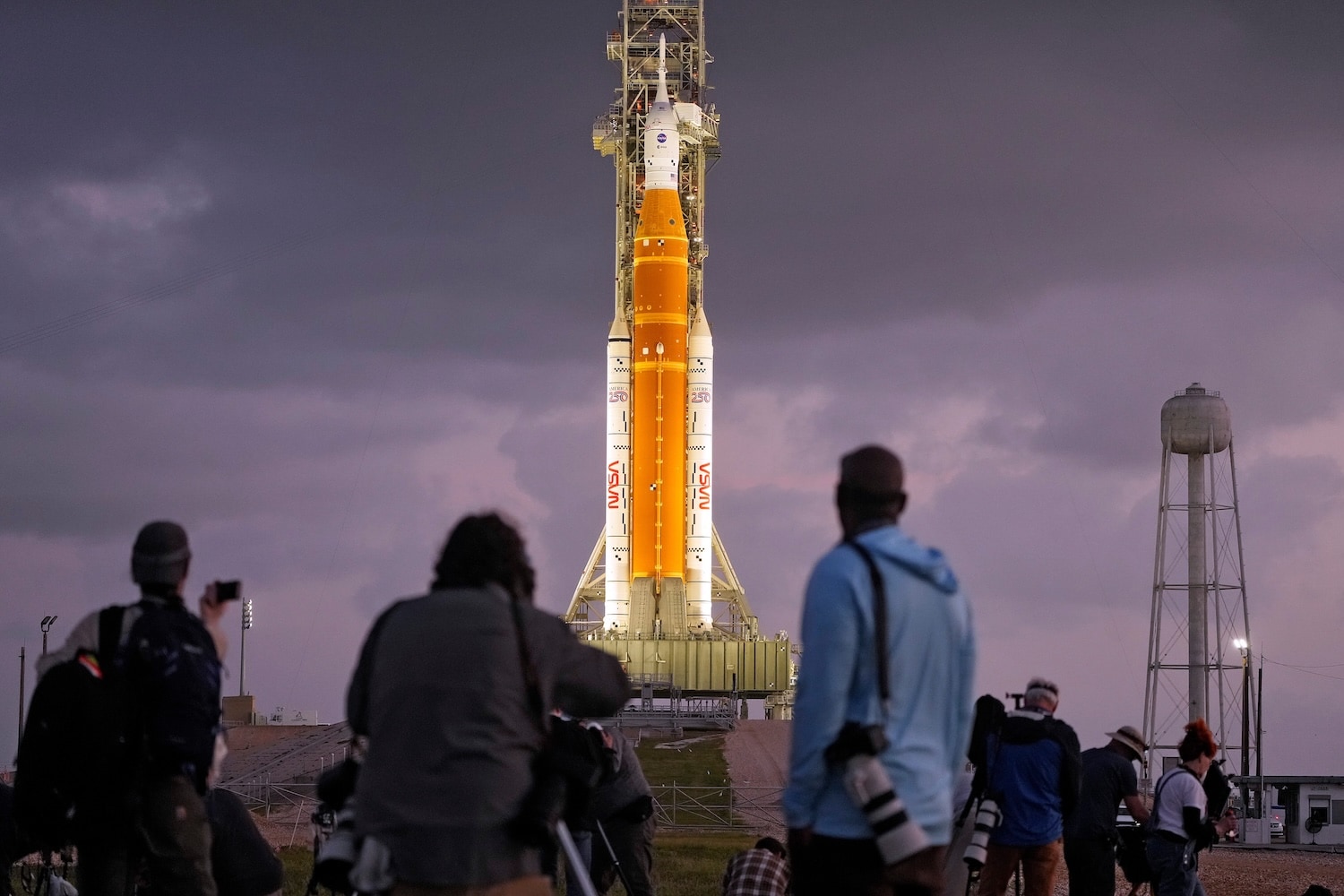
NASA is selling you a nostalgia trip wrapped in expensive carbon fiber.
The mainstream press wants you to believe Artemis II is the triumphant return of human exploration. They point to four brave astronauts, a shiny Orion capsule, and the first trip past low Earth orbit (LEO) in over half a century. They call it a "stepping stone" to Mars.
It isn't. It’s a $4 billion lap around the block.
If we look at the engineering reality, Artemis II is a mission defined by what it can’t do rather than what it can. It won’t land. It won’t stay. It won’t even enter lunar orbit. It is a "free-return trajectory" mission—a fancy way of saying NASA is throwing a ball into the air and catching it as it falls back down. In 1968, Apollo 8 did more with the computing power of a modern toaster.
We are cheering for a repeat of a fifty-year-old feat, funded by a budget that treats efficiency as an afterthought.
The SLS Debt Trap
The Space Launch System (SLS) is the anchor dragging down American spaceflight. Every time that orange rocket clears the tower, taxpayers are out at least $2 billion for the launch alone. That doesn’t include the decades of development costs.
Mainstream analysts argue that SLS is necessary because it’s the only "human-rated" heavy lift vehicle ready to go. That’s a circular logic trap. It’s the only one ready because NASA spent twenty years ensuring no other architecture could compete for those specific mission profiles.
Compare this to the rapid iteration we see in South Texas. While NASA meticulously polishes a single-use, expendable rocket that costs as much as a small country's GDP, the private sector is building reusable systems designed to fly, fail, and fly again. The contrarian truth is that Artemis II isn’t the beginning of a new era; it’s the final, gasping breath of the "cost-plus" contracting model where failure is subsidized and innovation is throttled by committee.
The Lunar Flyby Mirage
The public is being told that Artemis II is essential for testing "life support systems in deep space."
Let’s dismantle that. We have been running life support systems on the International Space Station (ISS) for over twenty years. While the radiation environment is different once you leave the Van Allen belts, a ten-day flyby provides negligible data that couldn't be gathered by uncrewed probes or simulated on the ground.
The mission profile is a "Hybrid Free Return." After the initial launch, the astronauts will spend roughly 24 hours in a High Earth Orbit (HEO) to test the ship. If everything is green, they burn for the Moon. If not, they drop back home. This is safe. It is conservative. It is also incredibly boring from a technical development standpoint.
We aren't testing how to live on the Moon. We aren't testing how to build a base. We are testing if we can still do what we did in the 1960s. The "innovation" here is mostly software-based, yet the hardware is a Frankenstein’s monster of Space Shuttle-era parts—literally. The SLS uses RS-25 engines that previously flew on the Shuttle. We are literally burning museum pieces to satisfy political mandates.
The Radiation Reality Check
One of the most touted "challenges" of Artemis II is the radiation exposure for the crew as they pass through the Van Allen belts and enter deep space. Critics and enthusiasts alike act as if this is a move into the Great Unknown.
It’s not. We have the data. We’ve had it since the Pioneer probes.
The dose the Artemis II crew will receive is roughly equivalent to what a career radiation worker is allowed to receive in a year. It’s a risk, yes, but it’s a managed one. Using this as a primary justification for a multi-billion dollar crewed flyby is a reach. If we were serious about deep space radiation, we would be testing active shielding or advanced materials on long-duration uncrewed missions, not sending four people on a week-long sprint just to see if they get a tan.
Why We Are Asking the Wrong Question
The question shouldn't be "When are we going back to the Moon?"
The question must be "Why are we going back with 1970s mission architecture?"
If the goal is a sustainable human presence on the Moon, Artemis II is a detour. A sustainable presence requires:
- Orbital Fuel Depots: Moving fuel, not just finished rockets.
- Massive Payload Capacity: You can't build a base with the tiny trunk space of an Orion capsule.
- Reusability: If you throw the rocket away, you lose the argument.
Artemis II achieves none of these. It uses an expendable rocket, a capsule with limited cargo, and no plan for refueling in orbit. It is a boutique mission designed for high-resolution photos and stirring speeches.
The Opportunity Cost of Nostalgia
I’ve seen programs stall because they were too big to fail and too expensive to succeed. Artemis is dangerously close to that inflection point. By pouring the vast majority of the deep-space budget into the SLS/Orion bottleneck, we are starving the very technologies that would actually make Mars a reality.
We could have spent the last decade perfecting orbital manufacturing or nuclear thermal propulsion. Instead, we built a bigger version of the Saturn V because it felt familiar. We are prioritizing the feeling of exploration over the utility of it.
The "People Also Ask" Evisceration
Q: Is Artemis II safe?
A: It’s as safe as explosive rocketry gets. But "safe" is the enemy of "fast." By over-engineering for a 99.9% safety rating on a flyby mission, we’ve ensured that the mission will be decades late and billions over budget. Space is dangerous. If you want 100% safety, stay in LEO.
Q: Why can't we just go to Mars?
A: Because we are obsessed with the Moon as a "proving ground." This is a fallacy. The Moon is a gravity well with no atmosphere. Mars is a gravity well with a thin atmosphere. The landing technologies are different. The life support requirements are different. Using the Moon to get to Mars is like practicing for a desert marathon by running in a swimming pool.
Q: Who are the astronauts?
A: Reid Wiseman, Victor Glover, Christina Koch, and Jeremy Hansen. They are elite, over-qualified, and incredibly brave. They are also being used as props for a mission that doesn't actually need them. An uncrewed Orion could do 100% of the technical data collection of Artemis II. We are putting humans on board for the "Human Interest" story.
The Logistics of a PR Win
NASA needs a win. After years of delays, they need a "Moonshot" moment to keep the funding flowing. Artemis II is that moment. It’s designed to be spectacular on television.
The four-person crew—diverse, articulate, and heroic—is the perfect face for a program that is otherwise a mess of bureaucratic red tape and aging tech. When they peek around the far side of the Moon and see the "Earthrise," the world will stop. We will all feel that 1968 magic again.
But don't confuse a feeling for progress.
When the Orion splashes down in the Pacific, we will be exactly where we were in 1972: capable of visiting the Moon, but with no way to stay there, and a price tag that makes the next trip a political liability.
The Hard Truth
If we want to be a multi-planetary species, we have to stop building monuments and start building infrastructure. Artemis II is a monument. It is a beautiful, expensive, soaring tribute to what we used to be able to do.
True disruption in space won't come from a government agency trying to recapture its youth. It will come from the cold, hard math of reusability and the willingness to leave the Moon behind in favor of destinations that actually matter.
Stop watching the countdown clocks and start watching the balance sheets. The Moon is a distraction. The rocket is a relic. The mission is a movie.
Go ahead and enjoy the show, but don't call it progress.


