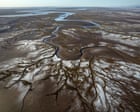
Elias stands at the edge of his alfalfa field in the Imperial Valley, the sun carving deep, tired lines into his face. He kicks at the dirt. It is cracked, thirsty, and stubborn. Below his boots, the earth holds a secret: it is drinking, but it is not satisfied. The water that sustains this patch of desert—this engine of winter greens that feeds a continent—is vanishing. It is moving up, evaporating into the thin, relentless air of the American West, or simply not arriving at all.
He looks toward the Colorado River, the lifeline that has allowed humanity to act as if this desert were a garden. The river is a ghost. In the high reaches, the snowpack is erratic. In the reservoirs, the bathtub rings are creeping higher, white scars against the red rock, marking a retreat that has been decades in the making.
For years, the three states of the Lower Basin—California, Arizona, and Nevada—have treated the river like an inheritance that would never run dry. They treated it like a bank account with an infinite balance. But the ledger is now in red.
The proposal on the table, a plan to cut water usage by three million acre-feet, is not just a policy document. It is an act of survival. It is the sound of a closing door.
The Math of Survival
To understand what three million acre-feet looks like, you have to stop thinking about abstract numbers. Think of an acre-foot as the amount of water it takes to flood an acre of land one foot deep. Now, imagine three million of those. It is enough water to supply roughly nine million households for a year.
The states are proposing to sacrifice this volume to keep the river from dipping below the critical elevation where the turbines at Hoover Dam stop spinning. When the turbines stop, the lights don’t just dim. They go out across the grid that powers the Southwest. The stakes are not just about a dry field or a brown lawn in Phoenix. They are about the stability of the entire region.
But look at how we arrived here. The original 1922 Colorado River Compact was signed during a period of unusually high rainfall. The people who signed it looked at the river, saw a surplus, and divided it up like spoils of war. They baked an error into the foundation of the West. They allocated water that didn’t exist in a dry year. For a century, we have been living on the credit of that mistake.
Now, the bill has come due.
The Weight of a Choice
There are, of course, faces behind the numbers. There is Maria, a city planner in Scottsdale, who stares at the suburban sprawl—the emerald-green lawns that look like a misplaced slice of the Midwest—and wonders how to tell the homeowners that their identity is a liability. There is the tribal leader whose ancestors have been here since the water flowed clear and cold, watching as the river is drained to satisfy the demands of cities that did not exist a hundred years ago.
The agreement between California, Arizona, and Nevada feels like a truce in a war that has been fought with lawyers for decades. Historically, these states have treated one another with the suspicion of rival siblings. California, with its senior rights, has often been the older brother taking the biggest slice of the pie. Arizona and Nevada have been the scrappier ones, forced to live off the crumbs of the Lower Basin.
To see them agree to share the pain is unusual. It is quiet. It is heavy.
But it is also incomplete.
The plan relies on federal money to pay farmers to leave their fields fallow. It is a transactional fix. You get paid not to plant, and the water stays in the river. This is the market at work. It is efficient. It is clean. But does it solve the underlying hunger?
Hardly.
The river is not a machine that can be tuned by adjusting a dial. It is a living system. When you pull water out of one place, the stress shifts to another. When you pay a farmer to stop growing crops, you lose the local economy that depended on those crops. The hardware stores close. The schools lose funding. The community thins out. This is the hidden cost of the arithmetic of thirst.
The Myth of the Infinite
We have been sold a story about the West. It is a story of conquest. We moved mountains, poured concrete, and bent the river to our will. We were told that as long as we were clever enough, as long as we had enough concrete and enough engineering, we could live anywhere we wanted.
But the river is telling a different story now. It is a story of limits.
The climate is shifting. The heat is more intense, staying longer, baking the soil into a crust that rejects the rain when it finally does come. The snowpack—the reservoir of the sky—is melting too early, running off before the crops need it, or before the dams can capture it.
Consider what happens next: If the states do not meet their targets, the federal government—the Bureau of Reclamation—could step in. They have the power to force cuts. That is a future where the courts decide who gets water and who gets dust. It is a future of litigation that lasts longer than the drought itself.
The agreement is a way of saying: "We will handle this ourselves. We will not let the feds dictate our collapse."
It is a desperate act of agency.
The Cost of Silence
I remember a day in 2012 when the water level at Lake Mead was dropping so rapidly you could see the bathtub ring forming on the canyon walls. It was a stark, bleached line. That line felt like a countdown.
We act as though the water will be there tomorrow. We turn the tap, and it flows. We flush the toilet, and it disappears. We are divorced from the source. The invisibility of the water is our greatest danger. If we saw the river as it is—anemic, struggling, gasping—would we still water our ornamental grasses in the middle of a July afternoon?
The proposals to save the river are not just technical adjustments. They are a reckoning with our own identity. We have to decide if we want to live in a desert, or if we want to pretend we don't.
There is no way to save the river without changing the way we live. We cannot have the same density of people, the same agricultural practices, and the same expectations of abundance if the water is not there. The math does not lie. It is cold. It is final.
A Quiet Necessity
The proposed plan is a stopgap. It is a bandage on a wound that runs deep into the bone. But it is a necessary bandage. It buys time. It creates the space for a conversation that we have been avoiding for a century.
What is the future of the West?
Is it a series of ghost towns left behind by the drying river? Or is it a reimagined region, one that accepts the arid reality of its climate?
We are standing at a threshold. The ink on the agreement is drying, but the water in the river is still dropping. The proposal is an acknowledgement that the era of expansion is over. The era of management, of sacrifice, and of hard choices has begun.
The river will continue to flow, even if it is a trickle. The question is not whether the water will survive. The river has been here for millions of years; it will find a way to exist, even if it is nothing more than a series of disconnected pools in a cracked bed. The question is whether we will survive with it.
Elias looks at the field one last time. He turns off the pump. The sudden silence is jarring. It is the sound of the future. He walks toward his truck, his boots crunching in the dry soil. He is not leaving yet. But he knows that the water, like everything else, is borrowed.
And the time to return it has finally arrived.