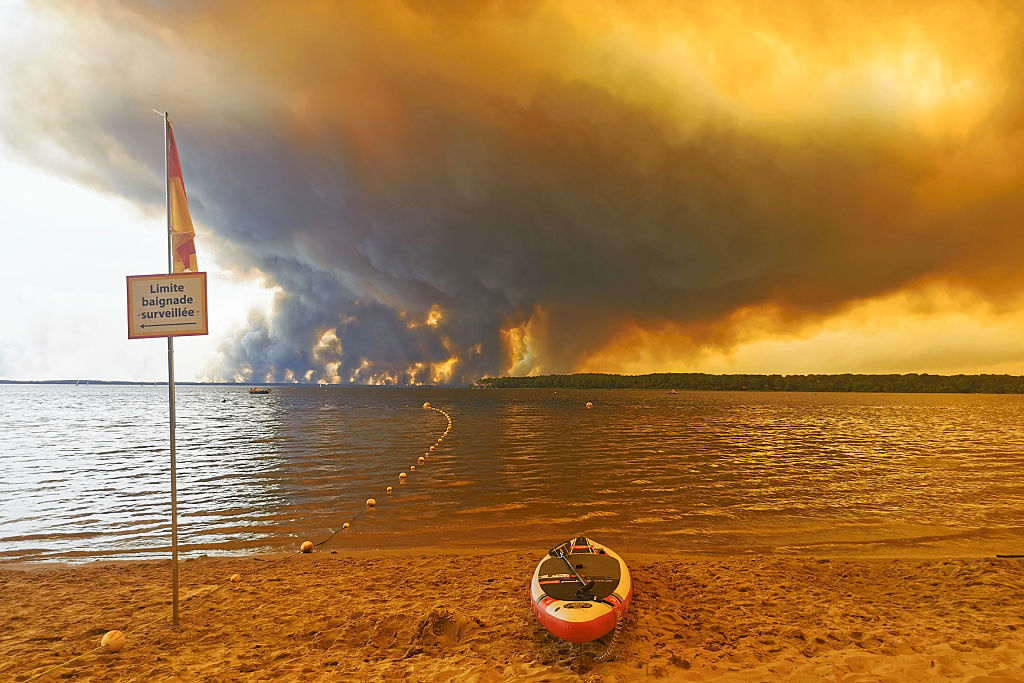
When a wildfire scales past conventional operational thresholds, it stops reacting to local atmospheric conditions and starts manufacturing its own. The emergence of pyrocumulonimbus activity in Western Europe—notably documented near Bordeaux—signals a critical structural failure in traditional suppression models. These fire-generated thunderstorms represent a thermodynamic tipping point where thermal energy release overwhelms standard boundary-layer meteorology. Understanding this phenomenon requires analyzing the mechanical transition from surface-level combustion to stratospheric plume dynamics.
The Thermodynamic Mechanics of Plume Genesis
Standard wildfire propagation relies on horizontal wind vectors, fuel continuity, and radiant heat transfer. Under extreme drought and high ambient temperatures, however, the energy release rate per unit area crosses a critical threshold.
The process operates through distinct physical phases:
- Surface Convective Acceleration: Enormous heat output superheats surface air, creating an intense, buoyant updraft. This acts as a continuous thermal chimney, drawing in ambient air from the periphery.
- Adiabatic Expansion and Condensation: As the superheated column of smoke, ash, and entrained water vapor accelerates upward into regions of lower atmospheric pressure, it expands and cools. When the temperature drops below the dew point, moisture condenses onto particulate matter, forming a towering pyrocumulus cloud.
- Stratospheric Penetration: If the thermal energy input remains unchecked, the convective momentum carries the plume past the tropopause, reaching altitudes between 10 and 15 kilometers. At this stage, the structure transitions into a mature pyrocumulonimbus (pyroCb), effectively functioning as a severe convective thunderstorm powered entirely by combustion energy rather than solar insolation.
This mechanical shift breaks standard fire behavior models. Ground crews operating under the assumption of predictable wind vectors face sudden, localized physics engines that invalidate tactical forecasts.
The Three Vectors of Operational Disruption
The transition from a standard surface fire to a pyroCb-generating inferno amplifies danger through three distinct feedback loops.
First, momentum-driven wind shear replaces prevailing meteorological patterns. The intense vacuum created by the thermal chimney pulls in surrounding air with destructive velocity. These locally generated winds frequently change direction instantaneously, cutting off escape routes and driving fire fronts laterally across established natural firebreaks.
Second, internal electrical activity introduces stochastic ignition sources. Mature pyrocumulonimbus clouds frequently generate cloud-to-ground lightning in the absence of ambient rain clouds. These dry lightning strikes ignite spot fires kilometers ahead of the primary front, expanding the perimeter faster than tactical assets can redeploy.
Third, the mechanics of plume collapse introduce severe mechanical hazards. When the energy output of the wildfire fluctuates or the storm exhausts its updraft fuel, the massive column of suspended ash, heavy timber, and burning debris loses buoyancy. This mass crashes downward in a severe downdraft, showering the surface with glowing embers and accelerating outward radial winds that overwhelm containment lines.
The Continental Exposure Shift in Europe
Historically, extreme fire clouds were studied primarily in the expansive wilderness zones of North America and Australia. Their documentation in Western Europe—specifically within regions subjected to prolonged seasonal drying like southwestern France and the Iberian Peninsula—points to a systemic accumulation of stress in forest ecosystems.
The structural vulnerability of European forests stems from two interacting variables:
- Fuel Aridity Indices: Prolonged heatwaves and cumulative precipitation deficits have driven live and dead fuel moisture content to historical lows, lowering the activation energy required for explosive combustion.
- Landscape Fragmentation: Unlike vast, contiguous taiga ecosystems, European landscapes feature a high-density matrix of wildland-urban interfaces. When a pyroCb forms over these fragmented zones, the resulting spot fires and erratic wind vectors bypass traditional zoning and suppression lines, threatening high-density infrastructure.
Consequently, emergency response agencies can no longer treat these events as statistical anomalies. The operational baseline must adjust to account for localized weather creation.
Strategic Operational Realignment
To manage fire environments capable of generating stratospheric plumes, tactical doctrine must shift from direct suppression to predictive evacuation and defensive zoning. When a convection column shows radar signatures indicative of vertical overshooting, human intervention on the perimeter becomes mathematically futile. Tactical resources must withdraw to hardened structural perimeters while automated sensing networks map the trajectory of potential plume collapses and lightning-induced spot fires. Shift capital investment toward real-time atmospheric sounding units and Doppler radar integration to track vertical plume momentum before surface observations register the hazard.