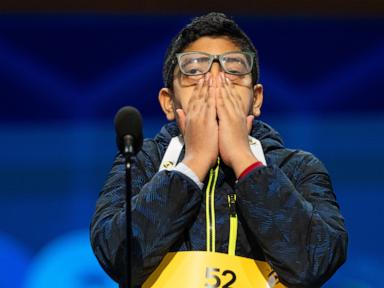
The hotel ballroom smells of industrial carpet cleaner and collective panic. Under the brutal fluorescent lights, a twelve-year-old child stands before a microphone that looks entirely too large for her. Her fingers are locked behind her back, twisting so tightly the knuckles are translucent white. She breathes in. The silence in the room is heavy, punctuated only by the soft click of a judge’s pen.
"Your word is schadenfreude."
To the casual observer watching the National Spelling Bee on a screen, this is a test of letters. We see a kid standing on a stage, digging through the recesses of their brain to pull out a sequence of vowels and consonants. We marvel at their poise. We shake our heads at the sheer volume of information packed into a mind that hasn't yet learned to drive a car.
But if you sit close enough to the stage—close enough to hear the shallow, rapid breathing of the competitors—you realize you aren't watching a vocabulary test. You are watching a quiet collision between two entirely different philosophies of human intelligence.
Most people assume every child on that stage is a linguistic prodigy, a miniature etymologist who sees the deep, interconnected roots of human speech. That is the romantic version of the story. The truth is far more complicated, far more human, and infinitely more agonizing. There are two distinct paths to this stage, and they represent a fundamental divide in how we learn, how we think, and what we value when we measure the human mind.
The Architect and the Vault
Consider two hypothetical competitors. We will call them Dev and Maya. They are both thirteen. They both spend upwards of forty hours a week staring at word lists, sacrificing their weekends, their friendships, and their sleep for a trophy that weighs nearly as much as they do.
Dev is an architect. When he hears a word, he doesn't just see a string of letters; he sees a historical map. If the word is pfeffernusse, his mind immediately travels to Germany. He breaks the word down into its phonetic components, analyzes the linguistic migration patterns, and applies rules of Germanic derivation. He understands the why. If Dev encounters a word he has never seen before in his life, he can often reconstruct it from scratch using logic, history, and structural awareness. He is a master of the language.
Then there is Maya. Maya is a vault.
Maya does not particularly care about the historical migration of Germanic consonants. She does not spend her evenings studying the subtle shifts between Latin and Old French. Instead, Maya has transformed her mind into a high-speed digital scanner. When she hears a word, she doesn't build it; she retrieves it. Her brain holds a vast, photographic grid of tens of thousands of terms, memorized through sheer, brutal repetition. She knows that pfeffernusse is spelled exactly that way because she has looked at the flashcard four hundred times.
For years, the spelling bee was a haven for the architects. The dictionary was smaller, the words were more predictable, and a deep understanding of linguistic roots was enough to carry a brilliant child to the final rounds. But over the last decade, a quiet revolution has taken place behind the scenes of the world's most famous academic competition. The words have become more obscure. The competition has grown fiercer.
To survive now, many competitors have abandoned the slow, beautiful art of mastery. They have embraced the cold efficiency of raw memorization.
The Software of Success
This shift didn't happen in a vacuum. It was driven by technology.
Walk into the bedroom of any top-tier spelling bee contender today, and you won't just see stacks of heavy, dog-eared dictionaries. You will see a glowing computer monitor running specialized spaced-repetition software. Algorithms have replaced intuitive study. These programs track exactly how long it takes for a human brain to forget a specific piece of information, prompting the user to review the word right at the moment it begins to slip from their memory.
It is beautiful, terrifying, and wildly effective.
By automating the forgetting curve, kids can cram an unprecedented volume of data into their working memory. They are no longer just learning a language; they are hacking their own neurology. A dedicated middle-schooler can now memorize fifty thousand words in less than two years.
But this technological leverage comes with a hidden cost. When you look at the statistics, the sheer volume of words required to win the modern bee has skyrocketed. The organizers have been forced to dig deeper into the most obscure corners of the unabridged dictionary to find words that can actually eliminate these algorithmic spellers.
This creates a vicious cycle. As the words become more detached from common usage, linguistic logic breaks down. When a word is an anomaly—a bizarre linguistic outlier that follows no known rules of etymology—the architect's strategy fails. Dev, relying on his deep understanding of roots, will guess based on logic and get eliminated. Maya, relying on the raw, unthinking printout in her mind, will spell it correctly without ever knowing what the word actually means.
The system, intentionally or not, has begun to reward the vault over the architect.
The Weight of the Invisible Screen
I remember sitting in an auditorium watching a young boy get eliminated on a word that felt deliberately cruel. It was a word with origins so muddy and a structure so chaotic that no amount of linguistic deduction could have saved him. When the bell rang signifying his error, his face didn't twist in anger or sadness. It went completely blank.
In that moment, you could see the exact weight of the invisible screen he had been staring at for months. He hadn't lost because he didn't understand English. He had lost because his internal database had a single, minute glitch in its code.
We live in a culture that loves to celebrate the end result of this process. We cheer for the confetti, the giant check, and the triumphant smile of the champion. But we rarely talk about what happens to a child's relationship with knowledge when learning becomes entirely transactional.
When you study through the lens of pure memorization, words lose their magic. They stop being tools for expression, stories of human migration, or vessels for poetry. They become obstacles to be cleared. They become data points.
There is a distinct anxiety that comes with this kind of preparation. If you learn a concept through mastery, you own it. It becomes a permanent part of how you view the world. If you learn a word through raw memorization, you are renting it. You know that the moment you stop reviewing those digital flashcards, the data will begin to evaporate. The vault will start to leak.
Many competitors admit, with a mix of relief and sadness, that within six months of the competition ending, they forget more than half of the words they spent years memorizing. The knowledge was never meant to stay. It was a temporary scaffolding built for a single weekend in May.
The Human Core of the Card Catalog
It is easy to look at the rise of the memorizers and feel a sense of cynical disappointment. We want our champions to be romantic geniuses, not human computers. We want them to love the words.
But if you look closer at the kids who rely on pure memorization, you find a different kind of human element, one that is perhaps even more poignant. It takes an extraordinary amount of grit, discipline, and emotional endurance to force the human brain to act like a hard drive. These children aren't cold; they are fiercely determined. They are navigating an immense amount of pressure, often carried on very small shoulders, using the most effective tool available to them.
The real tension isn't between the kids themselves. It is between the human mind and the systems we build to test it.
We see this everywhere, not just on the stage of the National Spelling Bee. We see it in standardized testing, in corporate performance metrics, and in our obsession with data-driven success. We consistently design systems that demand raw volume, and then we wonder why the poetry gets lost in the process. We create environments where Maya's vault is safe, but Dev's architecture is a liability.
Back on the stage, the twelve-year-old child takes a slow breath. She looks up at the judges, her eyes darting slightly to the left—the universal sign of a mind accessing a stored image. She isn't thinking about the German origin of the word. She isn't thinking about the meaning of pleasure derived from another's misfortune.
She is looking at a flashcard that exists only in the quiet, crowded theater of her own mind.
She begins to speak, her voice steadying with every letter she pulls from the dark.