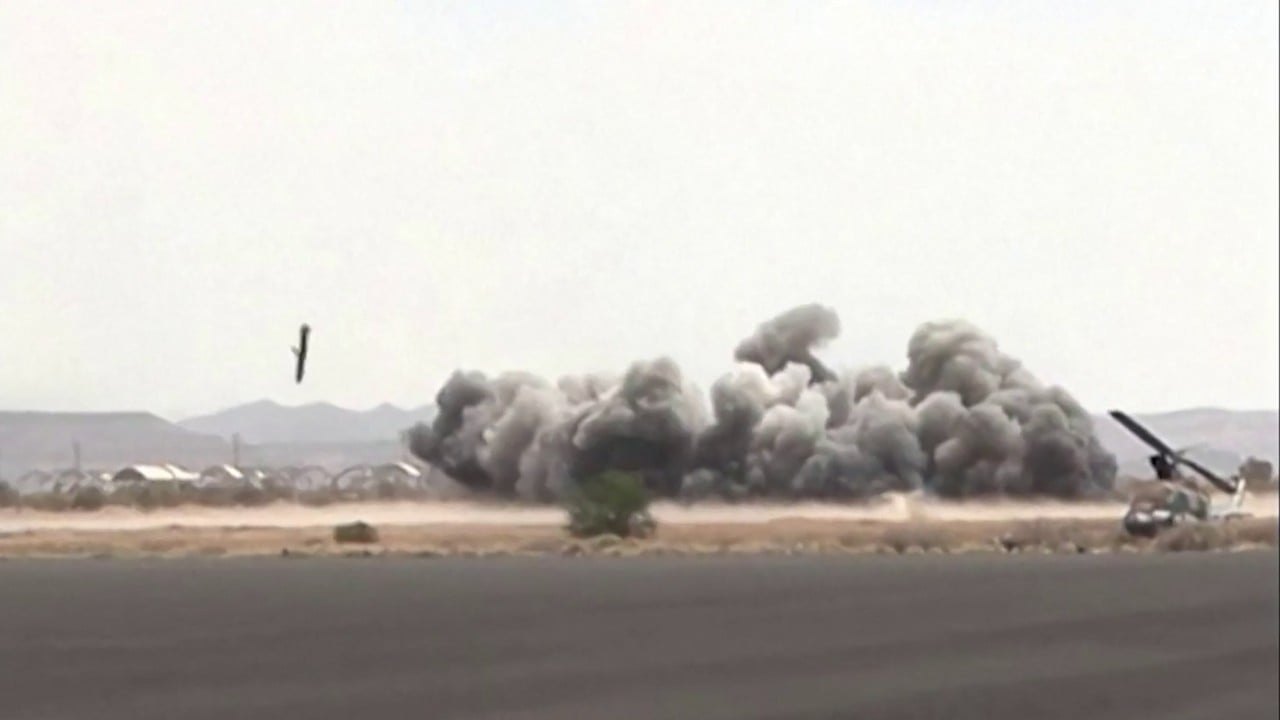
The four-year period of relative calm along the Saudi-Yemeni border has fractured. On July 13, 2026, the interception of ballistic missiles launched by the Houthi movement toward Saudi Arabia's southern Asir province, targeting Abha International Airport, marked the definitive end of the informal de-escalation framework established in March 2022. This exchange was triggered by an airstrike on the runway of Sanaa International Airport, an action claimed by the internationally recognized government of Yemen (supported by Riyadh) to block an unauthorized Iranian flight from landing.
To evaluate this development beyond the standard surface-level reporting of a "flare-up," we must analyze the structural dynamics of this escalation. The breakdown of the truce is not an isolated tactical spat; it is the logical consequence of asymmetric deterrence limits, sovereign airspace friction, and the structural collapse of backchannel diplomatic safety valves.
The Strategic Trilemma of the Saudi-Houthi Truce
To understand why this conflict reignited, we must first model the stabilization mechanism that kept it quiet since 2022. The relative peace was maintained by an unstable equilibrium of three competing strategic priorities:
- Saudi Arabia’s Economic Insulated Transition: Riyadh’s primary objective has been the preservation of its domestic security environment to safeguard the massive capital inflows required for Vision 2030. Physical vulnerability to Houthi missiles represents a direct risk premium on Saudi sovereign debt and foreign direct investment.
- The Houthi Search for Sovereign Legitimacy: For the Houthis, maintaining the status quo was conditional on converting their de facto military control over northern Yemen into de jure sovereign authority. Key to this is the unmonitored operationalization of Sanaa International Airport and the Red Sea ports.
- The Internationally Recognized Government's (IRG) Sovereignty Mandate: Heavily backed by Saudi Arabia but increasingly sidelined in direct Riyadh-Houthi talks, the IRG’s survival depends on asserting its legal status as the sole legitimate authority over Yemeni airspace and financial institutions.
This trilemma represents an unstable state. Any attempt by the Houthis to assert absolute sovereign control—such as bypassing civil aviation protocols to establish direct air corridors with Tehran—forces a reaction from either the IRG or Saudi Arabia.
The proximate trigger for the July 13 escalation was the decision by Houthi authorities to facilitate direct flights from Tehran, specifically returning a Houthi delegation that attended the funeral of Iran's late Supreme Leader. When the IRG asserted its technical sovereignty by launching a kinetic strike against the Sanaa runway to prevent an Iranian Mahan Air flight from landing, it collapsed the strategic ambiguity that had sustained the truce.
The Escalation Mechanics: Airspace as a Sovereign Friction Point
Airspace control is a zero-sum metric of state sovereignty. The structural cause-and-effect relationship that led to the missile launches on Abha International Airport can be mapped through a distinct sequence of escalation:
[Houthi-Tehran Flight Corridor established]
                  │
                  ▼
[IRG/Saudi Denial of Airspace Clearance]
                  │
                  ▼
[Kinetic Runway Strike on Sanaa Airport]
                  │
                  ▼
[Houthi Asymmetric Retaliation: Ballistic/Drone Salvo on Abha Airport]
                  │
                  ▼
[De-escalation Framework Collapse & Threat to Red Sea Shipping]
This sequence highlights a fundamental miscalculation in deterrence. The IRG and its Saudi backers assumed that the threat of disrupting northern Yemen’s fragile economic lifelines would deter the Houthis from formalizing an unmonitored air bridge to Iran. Conversely, the Houthis assumed that Saudi Arabia's extreme aversion to domestic disruption would prevent any kinetic intervention against Sanaa’s infrastructure.
By targeting Abha International Airport, the Houthis chose a highly symbolic target designed to maximize economic anxiety. Abha is the regional capital of Saudi Arabia's southern Asir province, representing both a key civilian transit hub and a geographical vulnerability near the Yemeni border.
Furthermore, the Houthi military command paired this strike with a warning to commercial airlines to avoid Saudi airspace. This move attempts to impose an economic blockade on Saudi civil aviation, leveraging the threat of regional flight disruptions to force a concession on the status of Sanaa International Airport.
Technical Asymmetry and the Cost-Exchange Curve
The military reality of this confrontation is characterized by a severe cost-exchange ratio asymmetry. This dynamic governs the sustainability of the conflict for both sides:
- The Air Defense Penalty: Saudi Arabia relies on high-end air defense systems, primarily the Patriot MIM-104 platform, to intercept Houthi threats. A single Patriot interceptor missile costs between $3 million and $4 million.
- The Low-Cost Offensive Salvo: The Houthi strike packages consist of a mix of solid-fuel ballistic missiles (often derived from Iranian Qiam or Fateh technology) and long-range loitering munitions (Samad-3 or Qasef-2K). The unit cost of these offensive systems ranges from $15,000 for a drone to approximately $100,000 for a tactical ballistic missile.
When the Houthis launch a mixed drone and missile salvo, the cost-exchange ratio easily exceeds 30:1 in favor of the attacker. While Saudi Arabia's air defense integration achieves a high interception rate—as demonstrated by the successful neutralization of the July 13 missile threat over the southern region—this defensive posture is financially and logistically draining over a prolonged campaign of attrition.
The vulnerability of Saudi Arabia’s critical infrastructure is not merely physical; it is financial. A sustained campaign of cheap Houthi drone strikes forces Saudi Arabia to expend limited air defense inventories, creating strategic vulnerabilities that can be exploited in broader regional contexts.
Geopolitical Implications: The Maritime Spillover Risk
The collapse of the Saudi-Houthi truce has immediate consequences for global supply chains, specifically through the maritime choke points of the Red Sea and the Bab al-Mandab Strait.
During previous rounds of escalation, Saudi Arabia mitigated vulnerabilities to its oil exports by utilizing the East-West Pipeline (Petroline), which transports crude from the Eastern Province to ports on the Red Sea coast, entirely bypassing the Persian Gulf and the Strait of Hormuz.
However, a re-energized Houthi campaign threatens this western export corridor. The Houthis possess significant anti-ship cruise missile (ASCM) inventories, fast attack craft, and waterborne improvised explosive devices (WBIEDs). If the conflict escalates back to pre-2022 levels, the Red Sea coast ceases to be a safe alternative for Saudi energy logistics. The threat profile shifts from localized border skirmishes to systemic global shipping disruption, driving up maritime insurance premiums and global energy volatility.
Strategic Playbook
The resumption of hostilities demands a shift in regional containment strategies. A passive defensive posture is no longer viable. To stabilize the southern border and secure critical infrastructure, Saudi Arabia and its international partners must execute a three-part strategic adjustments play:
1. Establish a Conditional Airspace Management Framework
The current binary standoff over Sanaa Airport—complete blockade versus unmonitored sovereign access—is unsustainable. Negotiations must focus on establishing a third-party neutral inspection regime for all incoming flights to northern Yemen, utilizing regional hubs like Amman or Muscat for cargo and passenger screening. This preserves the humanitarian function of the airport while managing the security risks of direct Iranian military resupply.
2. Transition Air Defense from Point Defense to Active Networked Interdiction
Saudi Arabia must shift its defense resources away from relying solely on expensive Patriot interceptors for point defense. Investing in and deploying directed-energy weapons (such as high-energy lasers) and lower-cost kinetic interceptors is critical to correcting the asymmetric cost-exchange curve. Furthermore, maritime interdiction networks in the Gulf of Aden must be tightened to disrupt the supply of missile components before they reach assembly points in northern Yemen.
3. Decouple Local Grievances from Regional Proxy Dynamics
The collapse of the latest prisoner exchange and the subsequent airport strikes show that local Yemeni actors (the IRG and the Houthis) retain significant agency to disrupt regional diplomatic alignments. Direct backchannel negotiations between Riyadh and Sanaa must be institutionalized, independent of broader US-Iran or regional diplomatic agreements. This ensures that localized disputes over civil aviation or banking regulations do not automatically trigger strategic missile exchanges.