The teacup on Elena’s desk didn’t break when the mortar hit three blocks away. It just hummed. A low, vibrating frequency that rippled across the surface of her Earl Grey tea. Elena, an operations manager for a mid-sized logistics firm in eastern Europe, didn't run for the basement. She didn't panic. She simply placed her palm flat against the wood, waited for the ceramic to stop singing, and went back to rerouting a fleet of trucks carrying medical supplies.
Fear is a luxury for people with nothing to do. For the rest of the world, conflict is no longer a breaking news banner on a television screen. It is an operational overhead cost. It is a supply chain bottleneck. It is the sudden, quiet realization that the map we used yesterday no longer exists today.
We are told that the global order is breaking down. Commentators speak of multi-polarity, shifting alliances, and macro-economic volatility as if they are weather patterns we can do nothing about but watch through a window. They give us cold statistics: billions of dollars lost to shipping diversions around the Suez Canal, skyrocketing cyber warfare insurance premiums, and the decoupling of major Western and Eastern manufacturing dependencies.
But statistics are just ghosts without the blood in them.
The real story of survival in a fractured world isn’t happening in the high-altitude summits of Switzerland or Washington. It is happening at desks like Elena’s. It is happening in boardroom meetings where leaders are realizing that the old playbook—built on the naive assumption that global peace was the default state of humanity—is dead.
To find stability when the ground itself is moving, we have to look at the three invisible pillars that keep a society, a business, and an individual upright when everything else is falling apart.
The Myth of the Global Safe Zone
For three decades, the global market operated on a beautiful, flawed premise: the world was flat, borders were merely lines on a spreadsheet, and efficiency was the ultimate god. We built just-in-time supply chains that spanned continents. A computer chip designed in California was manufactured in Taiwan, packaged in Malaysia, and sold in Germany. It was a masterpiece of human cooperation.
It was also terrifyingly fragile.
Consider a hypothetical company we will call Vanguard Components. For fifteen years, Vanguard sourced a specific, highly specialized neon gas required for their laser manufacturing from a single supplier in Mariupol, Ukraine. It made financial sense. The price was unmatched, the quality pristine. When conflict erupted, Vanguard’s production froze within forty-eight hours. They hadn't just lost a supplier; they had lost their ability to exist.
This is the vulnerability of hyper-efficiency. When you optimize a system entirely for cost, you strip out the fat. But the fat is where the resilience lives.
The first path to stability requires a brutal, unsentimental shift from efficiency to redundancy. This is not isolationism. It is not a panicked retreat behind national borders. It is the strategic diversification of dependence.
True resilience means building regional clusters. It means localized production nodes that can operate independently if the central nervous system gets severed. Think of it like the biology of a starfish. If you cut off a starfish’s arm, the organism doesn’t bleed to death. The arm grows back, and the central body keeps moving because its vital functions are decentralized.
Business leaders who survive the next decade will be those who willingly pay a premium for local, redundant infrastructure today to avoid paying the ultimate price of total collapse tomorrow. They are trading maximum short-term profit for long-term immortality.
The Digital Moat and the Human Firewall
We often think of warfare as steel and fire. Tanks crossing mud, drones buzzing in a grey sky. But the most devastating modern conflicts don't make a sound. They happen inside the server architecture of our municipal water grids, our banking apps, and our hospital databases.
Last year, a colleague of mine running a regional healthcare network woke up to find every monitor in their facility blank except for a single red text box demanding Bitcoin. The hackers weren't state actors in uniforms; they were state-sponsored ghosts operating from an apartment thousands of miles away. The hospital’s ambulances had to be diverted. Surgeries were postponed. The threat wasn't external or distant; it was inside the walls, carried through a single phishing email opened by a tired nurse at 3:00 AM.
This brings us to the second path: the realization that security is no longer an IT problem. It is a cultural imperative.
We have spent billions creating sophisticated digital fortresses, but we neglect the people holding the keys. True stability in a high-conflict era requires a radical reinvestment in human agency. It means moving away from the assumption that technology will save us, and toward the understanding that human psychological resilience is our primary line of defense.
When an organization is under constant digital siege, the solution isn't just more firewalls. It is training individuals to operate with a healthy, constructive skepticism. It is building systems that assume failure is inevitable. If a breach occurs, how quickly can the human components of your network isolate the infection and revert to analog operations?
During the Cold War, the Swiss built fallout shelters beneath every house. Today, the shelters we need are psychological and procedural. We must design our lives and our organizations so that we can lose our connection to the wider grid without losing our minds or our livelihoods.
The Premium on Social Capital
When the institutional structures around us begin to fray—when governments are distracted, international laws are ignored, and economic safety nets tear open—what is left?
Only the people you know.
We have profoundly underestimated the economic and stabilizing value of trust. In a stable world, trust is institutionalized. You trust that the contract will be enforced by the courts. You trust that the currency will hold its value because of the central bank. You trust that the police will answer the call.
In a conflict-ridden world, institutional trust evaporates. It is replaced by transactional and relational trust.
Let us return to Elena at her desk. When the transport routes through the northern corridor were blocked by a sudden border closure, she didn't call an embassy or file an insurance claim. She called a man named Marek, a competitor who ran a rival logistics firm two towns over. Three years prior, when Marek’s fleet was stranded in a snowstorm, Elena had let his drivers store their cargo in her warehouses for free, no contract signed, just a handshake over a cup of terrible coffee.
Elena didn’t ask Marek for a favor based on market rates. She asked him based on memory. Within an hour, Marek’s trucks were moving her cargo through an alternative southern pass.
This is not sentimentality. This is social capital. It is the most valuable asset on any balance sheet, yet it cannot be quantified by an accountant.
The third path to stability is the deliberate, aggressive cultivation of deep, local, and reciprocal relationships. The hyper-individualism of the early twenty-first century is a luxury of peaceful times. In times of friction, those who survive are those who belong to a tribe, a network, a community of mutual obligation.
We must invest in people when we do not need them, so that they will be there when we do.
The Silent Core
The afternoon sun began to dip below the horizon outside Elena’s window, casting long, fractured shadows across her maps. The humming in her teacup had stopped. The trucks were through the pass. The immediate crisis had passed, dissolving into the thousands of tiny, unrecorded victories that keep civilization running while the headlines scream of ruin.
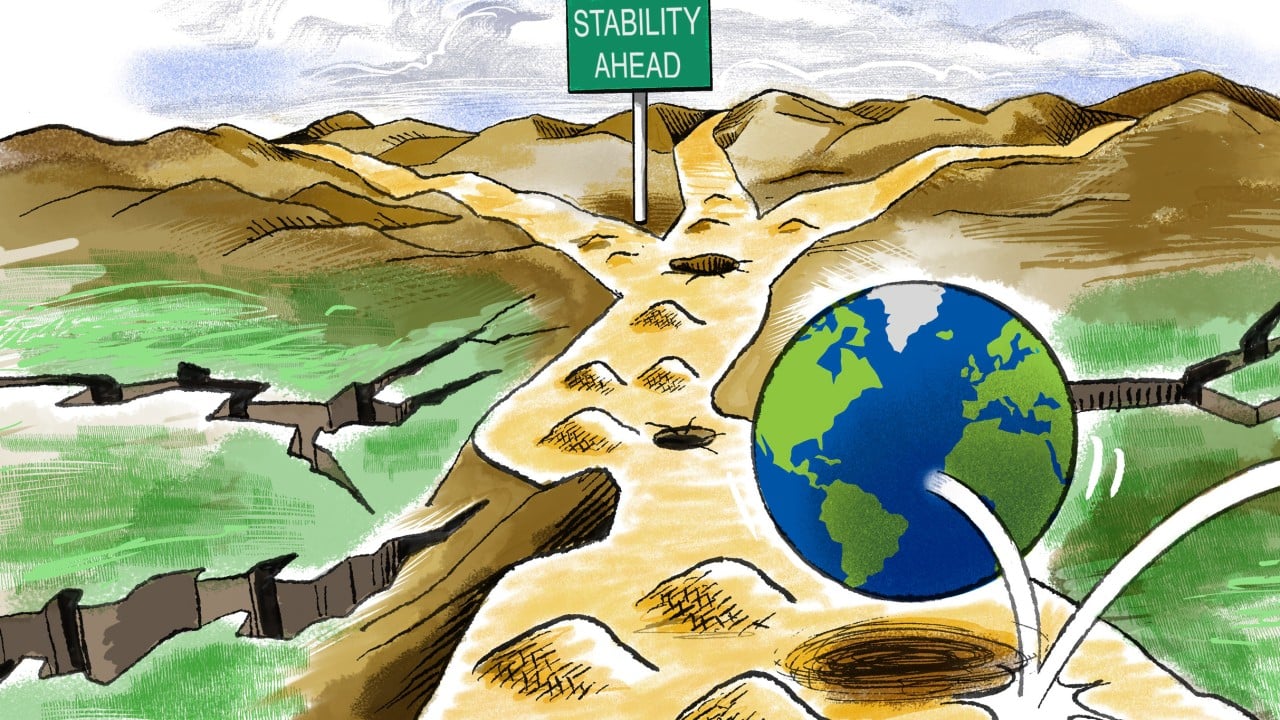
Stability is not the absence of chaos. It is the presence of an internal order strong enough to absorb the external shock.
We cannot stop the geopolitical plates from grinding against one another. We cannot control the madness of leaders or the sudden shifts of global markets. But we can control the radius of our own responsibility. We can build systems that don't shatter at the first sign of pressure. We can secure our digital borders, look after our people, and ensure that when the ground shakes, our foundations are anchored not in the shifting sands of global certainty, but in the bedrock of local resilience.
Elena took a slow sip of her cold tea, picked up her pen, and began planning the routes for tomorrow.