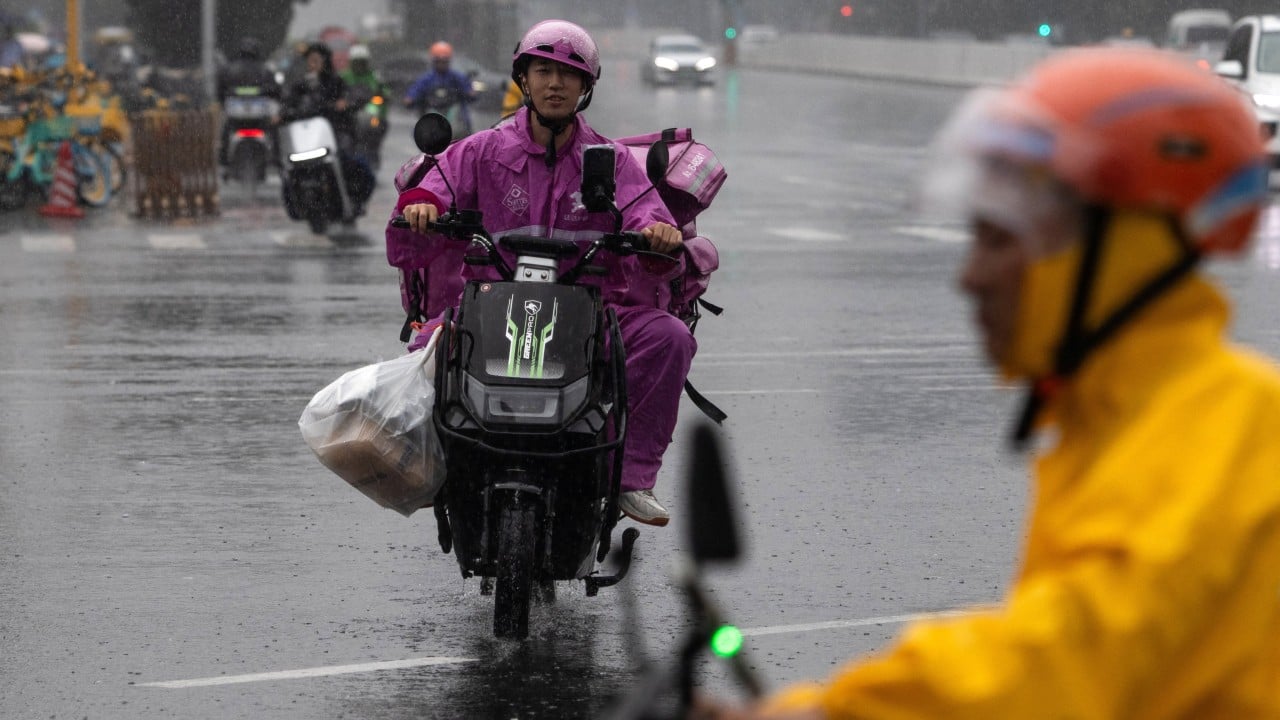
The asphalt in Beijing during the absolute furnace of July smells like hot tar and frying exhaust. Chen knows that smell intimately. He knows it through the visor of his helmet, through the sweat stinging the corners of his eyes, through the dull, relentless throb in his lower back that starts around hour six of a twelve-hour shift.
Chen is a hypothetical composite, yes, but he is built entirely from flesh-and-blood reality. He is one of millions navigating the concrete canyons of modern Chinese megacities, serving as the biological engine powering a multi-billion-dollar instant-delivery economy. You tap a screen. Thirty minutes later, steaming noodles or chilled milk appear at your door. You rarely think about the human cost embedded in that transaction. You think about your hunger.
Behind that door-to-door miracle, however, a quiet transformation is unfolding. China's tech giants—powerhouses like Meituan and Ele.me—are no longer content with optimizing delivery routes via smartphone apps alone. They are moving higher. Straight to the rider's head.
Consider what happens next: specialized helmets embedded with artificial intelligence, smart sensors, and communication arrays are rolling out across the asphalt. These are not merely pieces of protective gear designed to cushion a fall against a rogue delivery van. They are wearable command centers. They track biometric data, monitor fatigue levels, read facial micro-expressions, and feed a constant stream of algorithmic directives straight into the ears of men and women who are already running on fumes.
We have spent years talking about artificial intelligence as something confined to screens, data centers, and distant server farms. Now, it rests right on the crown of the skull.
To understand why this is happening, you have to understand the invisible geometry of urban logistics. The margins are razor-thin. The demand is infinite. A delivery rider in Shanghai or Shenzhen is not treated as a person navigating traffic; they are treated as a mobile node in a vast, hyper-optimized supply chain. Algorithms calculate travel times down to the single second. If a rider hits a red light, the system adjusts. If an elevator in a high-rise apartment complex is slow, the penalty ripples across the daily earnings.
Speed is currency. And speed kills.
For years, safety advocates have pointed to the alarming accident rates among food delivery fleets. The statistics are stark, grim, and frequently buried in quarterly reports. Riders weave dangerously through pedestrian walkways, blow past traffic signals, and stare downward at mounted phone screens while hurtling forward on electric bikes. The pressure to beat the clock creates a culture of perpetual hazard.
The tech companies saw this crisis. But instead of rewriting the algorithmic expectations that demand the impossible, they engineered a tool to manage the human variable within those expectations.
Enter the smart helmet.
Equipped with high-definition cameras, bone-conduction headphones, and real-time positioning modules, these devices do not just watch the road; they watch the rider. If Chen's eyelids start drooping too frequently after hour ten, the system detects the fatigue. A synthetic voice chimes in his ear, offering a warning or a mandated break. If he attempts to remove his helmet while on duty—a common trick used by exhausted workers to bypass tracking protocols—the system flags the infraction instantly.
It sounds benevolent on paper. Safety first. Artificial intelligence protecting the vulnerable worker from the perils of the modern gig economy.
Yet, step closer to the reality on the street, and the texture changes entirely.
Technology does not neutralize pressure simply by monitoring it. Often, it intensifies it. When every blink is quantified, when every micro-hesitation at a dangerous intersection is logged as an inefficiency, the worker ceases to be an independent agent. They become an extension of the machine. The helmet becomes a physical manifestation of the panopticon, strapped directly to the body, humming with data connections that link straight back to corporate headquarters.
We have been here before, historically speaking. Every major industrial shift promises liberation while tightening the leash. The loom, the assembly line, the punch clock, the smartphone—each innovation begins as a promise of efficiency and evolves into a system of totalized control. The smart helmet is simply the latest iteration of this ancient human struggle. It asks a profound question about the future of labor: how much of our autonomy are we willing to trade for the sake of a hotter lunch delivered two minutes faster?
The answer, written in real-time across the streets of Beijing and Guangzhou, is complicated. Many riders, struggling to feed families thousands of miles away in rural provinces, welcome any tool that keeps them from getting struck by a delivery truck. For them, survival supersedes philosophy. Safety, even when enforced by a cold algorithm, is still safety.
At the same time, the psychological weight of constant surveillance is real. Imagine working an arduous physical job where your supervisor is not a human being who might sympathize with a bad morning, but a neural network that evaluates your productivity down to the millisecond. There is no room for grief, no room for exhaustion, no room for being human.
This is the hidden cost of our convenience. Every time we demand absolute frictionless service, we invite the machine deeper into the human experience. We delegate the management of our fellow citizens to lines of code written by engineers sitting in climate-controlled glass towers miles away from the heat of the asphalt.
The helmets are out there now. They are blinking in the traffic. They are recording, calculating, and whispering instructions into tired ears.
The future of work is not arriving with a dramatic sci-fi explosion. It is arriving quietly, strapped securely beneath a chin strap, humming softly in the summer heat, waiting for the next ping.

