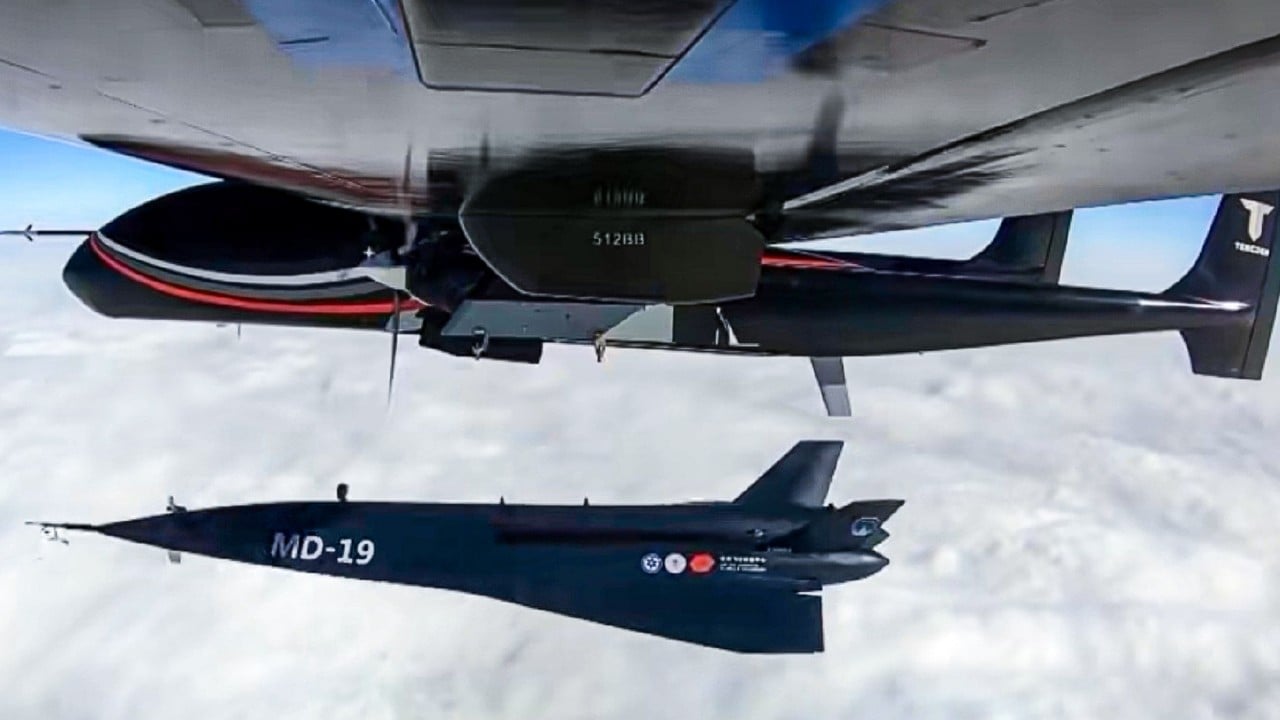
The physical viability of low-altitude hypersonic flight hinges on a brutal engineering trade-off between radar evasion and thermal-structural destruction. The Chinese Academy of Sciences (CAS) Stable Support Programme for Basic Research Youth Teams launched an exploration into the fundamental mechanics of sea-skimming hypersonic flight, targeting speeds greater than Mach 5 at altitude limits below the radar horizon. While traditional anti-ship ballistic missiles—such as the DF-26—and high-altitude hypersonic glide vehicles (HGVs) like the DF-17 rely on extreme altitude to minimize atmospheric resistance, a sea-skimming hypersonic missile attempts to exploit the curvature of the Earth to truncate a defender’s reaction window.
The operational premise of this architecture is the systemic exploitation of radar horizon geometry. For a standard shipborne radar antenna mounted at a height of 30 meters targeting an incoming missile flying at an altitude of 10 meters, the geometric horizon limits initial detection to approximately 25 to 28 kilometers. At Mach 5 (approximately 1,700 meters per second), this bounds the absolute defense window to fewer than 17 seconds. This compression of time challenges the command-and-control loop of naval surface groups. However, executing this flight profile introduces multi-domain physical bottlenecks that threaten to invalidate the platform's deployment before a single kinetic interceptor is fired.
The Triad of Low Altitude Hypersonic Impediments
To evaluate the feasibility of a low-altitude hypersonic platform, the system must be analyzed through three fixed constraints: fluid-dynamic drag, extreme aerothermal loading, and plasma-induced sensor isolation.
1. The Drag Coefficient Expansion
Atmospheric density at sea level ($\rho \approx 1.225 \text{ kg/m}^3$) is roughly three orders of magnitude greater than the density at typical HGV cruise altitudes of 30 to 40 kilometers. Because aerodynamic drag scales quadratically with velocity and linearly with air density, according to the standard relationship:
$$F_d = \frac{1}{2} \rho v^2 C_d A$$
the propulsive force required to sustain Mach 5 at sea level is mathematically prohibitive under current scramjet and ramjet designs. The power required to overcome this drag scales cubically with velocity ($P = F_d \cdot v$). Sustaining this flight profile demands an energy density that exceeds the volumetric limits of any tactical missile hull, severely limiting operational range.
2. Extreme Aerothermal Dissipation and Boundary Layer Mechanics
The kinetic energy converted into thermal energy within the stagnation point and boundary layer of a sea-skimming vehicle creates an extreme thermal environment. At Mach 5 near sea level, stagnation temperatures exceed 1,500 Kelvin (1,227°C), surpassing the structural thresholds of high-strength aerospace alloys.
- Materials Degradation: Titanium alloys lose structural integrity above 870 Kelvin. Specialized Ultra-High-Temperature Ceramics (UHTCs) such as hafnium diboride ($\text{HfB}_2$) can withstand these temperatures but are highly brittle and susceptible to catastrophic structural failure under the violent acoustic and turbulent vibration modes of low-altitude flight.
- Ablative Limits: Traditional passive ablative shielding adds prohibitive mass, which further exacerbates the drag-to-thrust penalty. Active cooling loops, utilizing endothermic hydrocarbon fuels as coolants, introduce deep mechanical complexity and scale up the vehicle’s dry weight.
3. The Boundary Layer Sensor Bottleneck
The combination of extreme temperature and pressure at sea level induces localized ionization of the atmospheric gas surrounding the missile nosecone. This creates a dense plasma sheath.
This plasma layer acts as an electromagnetic shield, absorbing and reflecting radio frequency signals. The consequence is terminal sensor blackout. The missile cannot utilize active radar homing or receive mid-course GPS/BeiDou correction updates through the plasma shield.
Compounding this, an optical or infrared window would be blinded by the intense self-luminescence of the heated boundary layer. A weapon traveling at Mach 5 at 10 meters altitude is functionally blind, relying entirely on uncorrected inertial guidance systems that drift rapidly over extended operational ranges.
The Interfacial Wave and Ground Effect Anomaly
Operating a multi-ton missile at Mach 5 within 10 to 15 meters of the ocean surface introduces catastrophic fluid-structure interactions. When an object flies in close proximity to a boundary, it enters the ground effect regime, altering the lift-to-drag ratio and shifting the aerodynamic center of pressure.
At hypersonic velocities, the shock wave generated by the missile's nosecone compresses the air between the underbelly of the vehicle and the water surface. This compressed air creates an irregular, ultra-high-pressure cushion that reflects off the ocean's surface and strikes the aft sections of the missile body.
Because the ocean surface is a dynamic, non-Newtonian boundary characterized by varying wave heights and spray, this shock reflection is highly volatile. The rapid fluctuation in aerodynamic pitching moments creates high-frequency aeroelastic instabilities. To prevent pitch-up or surface impact, the flight control actuators must execute corrections at millisecond intervals. However, structural control surfaces operating in a hypersonic boundary layer at sea level experience extreme aerodynamic stall and severe mechanical fatigue, making sustained, stable flight through wave troughs highly improbable with current actuator physics.
Naval Defensive Network Integration
The tactical efficacy of a sea-skimming hypersonic weapon is further diminished by the evolution of defensive battle networks. The reliance on ship-centered radar horizons is a legacy vulnerability that modern distributed naval doctrine has largely mitigated.
The US Navy’s Naval Integrated Fire Control-Counter Air (NIFC-CA) architecture decouples the sensor from the shooter. By networking airborne assets—such as E-2D Advanced Hawkeye airborne early warning aircraft or forward-deployed F-35 fighters—with surface combatants via the Cooperative Engagement Capability (CEC), the defense grid projects its tracking horizon hundreds of miles beyond the physical line-of-sight of a surface ship's radar mast.
[Airborne Sensor: E-2D / F-35]
       │ (Tracks threat over the horizon)
       ▼ (Real-time data link via CEC)
[Aegis Weapon System / Surface Destroyer]
       │
       ▼ (Launches Interceptor)
[SM-6 / ESSM Block 2 Intercept]
Under this distributed tracking paradigm, an incoming sea-skimming missile is detected shortly after launch or as it crosses the radar horizon of outer-tier airborne pickets. This restores the defensive reaction window from 17 seconds to several minutes. This expanded window permits the deployment of layered kinetic and non-kinetic countermeasures:
- Outer Tier Engagement: The Aegis Weapon System deploys the RIM-174 Standard ERI (SM-6), which utilizes an active radar seeker to execute over-the-horizon intercepts based entirely on remote tracking data provided by NIFC-CA nodes.
- Inner Tier Saturation Defense: For weapons that penetrate the outer tier, the Evolved Sea Sparrow Missile (ESSM) Block 2 leverages its dual-mode active/passive homing head to engage high-speed targets without requiring continuous illumination from the host ship's fire control radars.
- Non-Kinetic Disruption: Because the missile's tracking systems must emerge from the plasma shield during its final terminal phase to lock onto a moving warship, it becomes highly vulnerable to High-Power Microwave (HPM) systems and electronic warfare suites (such as the AN/SLQ-32(V)7 SEWIP Block 3). These systems disrupt or permanently blind the missile’s terminal guidance electronics, causing it to miss the target entirely due to the extreme turn-radius penalties associated with hypersonic velocities.
The strategic deployment of a low-altitude hypersonic weapon platform remains restricted by foundational physics. Rather than field a standalone sea-skimming hypersonic missile, weapon developers are forced to pivot toward asymmetric, multi-tier missile salvos. This operational doctrine leverages low-altitude subsonic stealth cruise missiles and high-altitude ballistic hypersonics launched simultaneously to saturate a carrier strike group's computing and engagement capacity. Developing low-altitude hypersonic flight remains an ongoing basic research initiative rather than a near-term operational reality.